

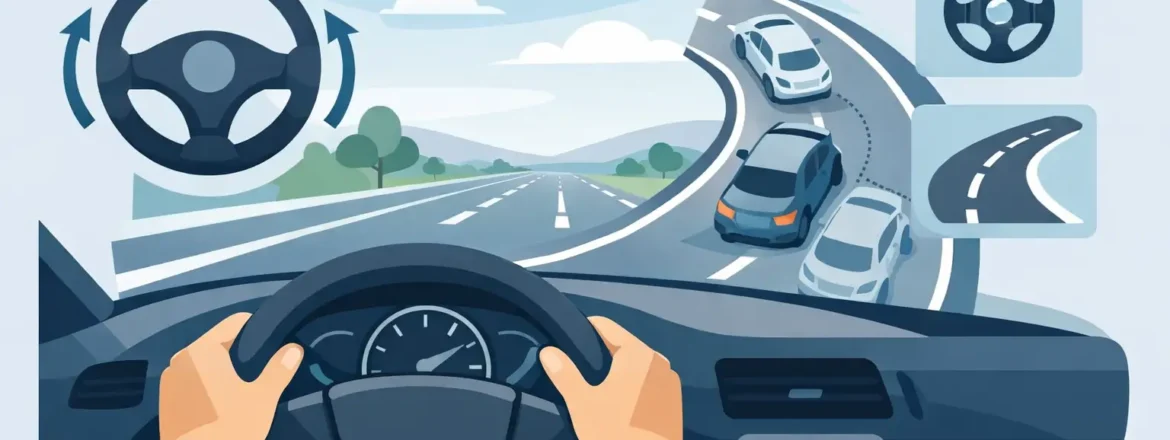
A car can feel surprisingly large when you are new to driving. One moment you are trying to stay centred in your lane; the next, a roundabout, tight car park or residential corner asks you to turn smoothly while checking for other road users. Good steering control for beginners is not about gripping the wheel harder. It is about looking ahead, using calm hand movements and giving yourself enough time to respond.
For learner drivers in Melbourne’s western suburbs, this skill matters well beyond the VicRoads practical test. Confident steering helps you keep a safe road position in Tarneit traffic, negotiate Werribee roundabouts and park accurately in busy shopping areas. It also makes the rest of driving feel more manageable.
Start with the right driving position
Steering becomes much easier when your seat and mirrors are set correctly. Before moving off, sit so your back is supported by the seat and your shoulders can stay relaxed. You should be able to press the brake pedal firmly without stretching, while keeping a slight bend in your knees.
Set the steering wheel so you can hold it comfortably with your hands around the 9 and 3 positions. Your arms should have a gentle bend, not be locked straight. If you sit too close, your arms have little room to move. If you sit too far away, you may pull yourself forward during turns and lose a stable view of the road.
Keep both hands on the wheel whenever practical. You will briefly remove one hand for indicators, wipers or gears in a manual car, but return it as soon as you can. Avoid resting a hand inside the wheel or holding the wheel from the bottom. These positions reduce control if you need to steer quickly around a hazard.
Look where you want the car to go
One of the most useful lessons in steering is simple: your hands tend to follow your eyes. If you stare at the kerb because you are worried about hitting it, you may unintentionally guide the car closer to it. Instead, look through the turn towards the space where you want the car to finish.
On a left turn at an intersection, check for pedestrians and cyclists, then look into the road you are entering. On a roundabout, look towards your intended exit while still scanning for traffic. When travelling along a straight road, keep your vision well ahead rather than focusing only on the few metres in front of the bonnet.
This does not mean ignoring mirrors or nearby hazards. Good drivers move their eyes regularly: far ahead for direction, closer ahead for immediate risks, mirrors for awareness, then back to where the vehicle is heading. With practice, this becomes natural and helps prevent sudden, late steering corrections.
Use smooth movements, not quick grabs
Modern vehicles have power steering, so the wheel needs less effort than many learners expect. A light, controlled grip is better than a tight one. When you grip too firmly, your shoulders become tense and your steering often turns jerky.
For normal bends and gentle corners, guide the wheel gradually with both hands. Let the wheel move through your hands in a controlled way, then guide it back as the car straightens. Do not let it spin freely back to centre. You remain responsible for the direction of the vehicle at all times.
For tighter low-speed turns, such as entering a driveway, parking or completing a three-point turn, use a hand-over-hand or push-pull technique taught by your instructor. The best method depends on the turn, the vehicle and how much steering lock is needed. The key is to keep control of the wheel and avoid crossing your arms in a way that leaves you unable to make a quick adjustment.
Try to steer while the car is rolling slowly rather than turning the wheel heavily when stopped. This is kinder to the tyres and steering system, and it gives you a clearer sense of how the vehicle responds. In a car park, patience is more useful than speed. Small movements and a proper observation routine will produce a much neater result than rushing.
Steering control for beginners at corners and roundabouts
Corners are where many learner drivers either turn too early and cut close to the kerb, or turn too late and drift wide. The solution is not to swing the vehicle out before the turn. Stay in your lane, reduce speed early and begin steering only when you have reached the correct position to enter the new road.
Approach at a speed that allows you to steer smoothly. Braking hard in the middle of a turn can unsettle both the car and the driver. As a general habit, check mirrors, signal when required, slow down before the corner, observe for pedestrians and traffic, then steer through the turn with your eyes focused ahead.
Roundabouts require the same calm approach, with more observation. Select the correct lane early, use the appropriate signal, slow enough to assess vehicles already on the roundabout, and enter only when it is safe. Once you are moving, follow the curve of your lane. Do not cut across lane markings or make sharp corrections because another vehicle feels close. Keep a safe space, maintain your lane and exit with control.
In Melbourne’s western suburbs, roundabouts vary from quiet residential intersections to larger multi-lane layouts. A learner may handle a small local roundabout confidently but feel uncertain at a busier one near a main road. That is normal. Build the skill gradually, starting with quieter locations before practising more complex traffic situations with an instructor.
Stay centred in your lane
Lane position is a steering skill, even on a straight road. Learners often make repeated little left-right corrections because they are looking too close to the car. Looking further ahead gives you more time to notice drift and correct it gently.
Use visual references that suit your seating position. You may notice the lane markings sitting a consistent distance from the lower edge of the windscreen, or use the road ahead to judge whether the car is centred. Do not rely on looking down at the lane line beside your door. By the time you notice it closely, the correction may be too late or too sharp.
Wind, uneven road surfaces, passing trucks and narrow lanes can make a car move slightly. Keep your hands relaxed and respond with small inputs. Over-correcting is often more dangerous than the original drift, particularly at higher speeds.
Match steering to your speed
The faster you travel, the smaller and gentler your steering movements must be. A small turn of the wheel at 60 km/h changes the vehicle’s path much more quickly than the same movement in a car park. This is why speed control and steering control work together.
If a bend looks tighter than expected, do not panic and yank the wheel. Ease off the accelerator if safe, keep looking through the bend and make a smooth adjustment. Sudden steering can reduce tyre grip, especially on wet roads. Leave a sensible gap from the vehicle ahead so you have time to respond without harsh braking or swerving.
During wet Melbourne weather, slow down early for corners, keep your steering gentle and avoid sudden changes of direction. Puddles, painted road markings and oily surfaces can be slippery. Your aim is to keep the car settled and predictable.
Common habits that make steering harder
New drivers often create extra difficulty without realising it. Holding the wheel too tightly causes tension. Looking at the kerb encourages kerb-side drift. Turning while travelling too fast makes the corner feel rushed. Waiting until the last second to slow down or signal gives you less attention for steering and observation.
Another common habit is steering with one hand while the other hand stays on the gear lever. In a manual car, select the gear you need, then return your hand to the wheel. You need two-handed control most when traffic conditions change quickly.
Do not confuse smooth steering with slow reactions. You should still respond promptly to hazards, but a prompt response can be calm and measured. The more often you practise in the right conditions, the less you will need to think about every hand movement.
Practise with a clear goal each lesson
A useful driving lesson does more than cover kilometres. Pick one steering goal and repeat it in different situations. You might focus on staying centred on a straight suburban road, entering roundabouts without cutting corners, or reversing into a parking bay using slow and accurate movements.
Ask for feedback that is specific. Rather than hearing that a turn was “not quite right”, find out whether you began turning too early, approached too fast, looked at the kerb or did not return the wheel smoothly. This turns a frustrating mistake into something you can improve on the next attempt.
At Victest Driving School, one-on-one lessons can help you practise steering at a pace that suits your confidence, while building the observation, speed control and road positioning needed for real driving and the practical test. A patient instructor can also help nervous learners understand that a mistake is feedback, not failure.
The next time you sit behind the wheel, take a breath before moving off. Set your position, look well ahead and give yourself time at every turn. Calm hands and clear vision will do more for your steering than trying to force the car into the right place.