

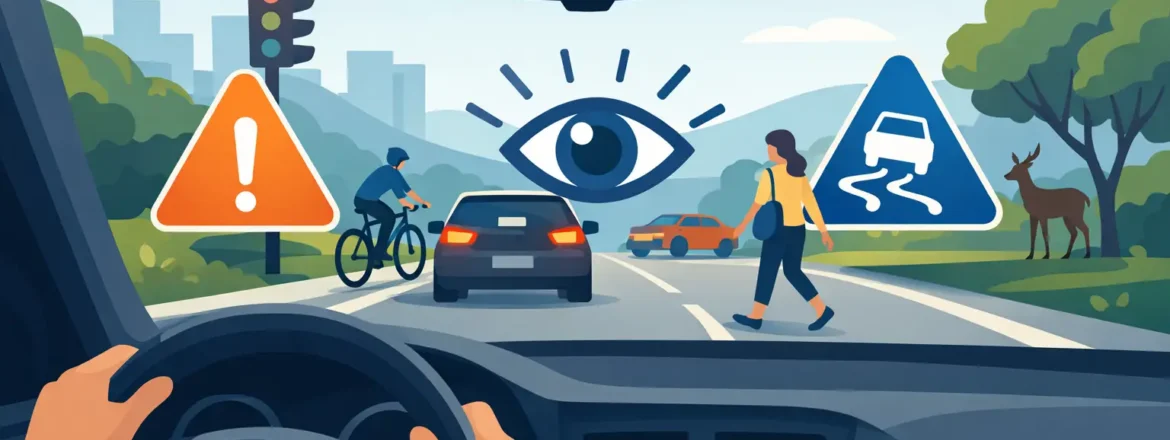
A parked car door opening on a busy Tarneit street can become a problem in seconds. So can a child stepping out near a school crossing, a ute reversing from a Werribee driveway, or traffic suddenly slowing on the Princes Freeway. Hazard perception for learner drivers is the skill of seeing these risks early enough to make a calm, safe decision – before you need to brake hard or swerve.
This is not about being frightened of every car, pedestrian or bicycle. Good drivers do not assume the worst will happen at every moment. They stay alert, read the road ahead and give themselves time and space to respond if something changes.
For learners preparing for their Ps in Melbourne’s western suburbs, stronger hazard perception helps with far more than the Hazard Perception Test. It makes turning, changing lanes, entering traffic and driving on unfamiliar roads feel more controlled. It also helps show a driving tester that you are making safe decisions independently.
What counts as a hazard?
A hazard is anything that could affect your path, speed or safety. It may already be in front of you, such as a vehicle braking ahead. It may also be a possible risk that has not happened yet, such as a pedestrian waiting near the kerb or a car positioned to pull out from a side street.
New drivers often notice hazards once they are directly in front of the car. Experienced drivers look further ahead and ask, “What could happen next?” That extra thinking time is what creates safer driving.
Not every potential hazard needs immediate braking. A person standing well back from the road may simply be waiting for someone. A vehicle with its indicator on may turn, but it could also be waiting for another vehicle. The right response depends on the situation. Your job is to recognise the possibility, check your surroundings and adjust early if needed.
Hazard perception for learner drivers on Melbourne roads
Melbourne’s western suburbs offer plenty of real-world practice. Wide roads, busy shopping areas, school zones, roundabouts, railway crossings and new housing estates all require different types of awareness.
Look well beyond the car in front
If you only watch the rear of the car ahead, you will react late. Look through its windows where possible and scan several vehicles ahead. Brake lights further up, a queue near traffic lights or a bus pulling away can give you an early warning that traffic is slowing.
Keep a safe gap so you can respond progressively. In wet weather, at night or when visibility is poor, increase that gap. Following too closely is one of the quickest ways for a small change in traffic to become a sudden braking situation.
Read parked cars and driveways
On residential streets in Truganina, Hoppers Crossing or Wyndham Vale, parked vehicles create blind spots. A person may walk out from between cars, a door may open, or another driver may pull away without seeing you.
Slow slightly when passing tightly parked cars and look for clues: people inside a vehicle, brake lights, wheels turned out, reversing lights, or a gap that hides a pedestrian. Be especially cautious near shops, schools and sporting grounds, where people can be distracted or carrying bags and equipment.
Driveways deserve the same attention. A vehicle reversing out has limited vision and may not see you straight away. Do not rely on eye contact alone. Be ready to cover the brake and leave room where practical.
Expect movement around pedestrians and cyclists
Pedestrians are unpredictable because they are not always focused on traffic. Someone looking at a mobile, rushing for a bus or managing young children may step toward the road without checking properly. At crossings, slow down early and be prepared to stop.
When passing cyclists, give them space and expect them to move around potholes, parked cars, drains or opening doors. A cyclist may need to take more of the lane than you expect. Patience is safer than trying to squeeze through a narrow gap.
Take extra care at intersections and roundabouts
Many serious hazards develop at intersections because several road users are making decisions at once. Scan right, left and right again before moving off where required. Look for vehicles turning across your path, motorcycles hidden behind larger cars, pedestrians entering the crossing and drivers who may not give way correctly.
At roundabouts, approach at a speed that lets you observe and decide. Check for traffic already circulating, indicate correctly and keep watching as you enter. Do not assume another driver will indicate perfectly or leave the roundabout where you expect. If you are unsure, waiting briefly is usually the safer choice.
Use a simple scan routine
Hazard perception improves with a repeatable routine, not by staring nervously at every object. Keep your eyes moving between the road ahead, mirrors, side areas and the space where you intend to travel.
A useful approach is to scan far ahead first, then bring your focus back to the traffic in front, check mirrors regularly, and glance toward side streets, parked cars and footpaths. Before braking, turning, changing lanes or moving off, complete the relevant mirror checks and head checks.
Your mirrors tell you what is behind and beside you. Your forward view tells you where the next problem may develop. Both matter. Learners sometimes focus so hard on mirror checks that they stop reading the road ahead. The goal is smooth, purposeful observation rather than rushed head movements.
Respond early, not dramatically
Spotting a hazard is only the first part. The next step is choosing a safe response. Often, that response is simply easing off the accelerator and creating more space. You may need to brake gently, delay a lane change, prepare to stop or wait for a clearer gap.
Sudden swerving can create a second hazard, particularly if you have not checked adjacent lanes. Strong hazard perception gives you time to avoid panic reactions. If a vehicle begins edging out of a driveway, for example, reducing speed early is usually safer than leaving the decision until the last moment.
Keep your hands steady and look where you want the car to go. If you stare at the danger, it is easier to steer towards it. Looking ahead to the safe path helps you stay composed.
Practise the Hazard Perception Test the right way
The Hazard Perception Test asks you to identify developing traffic situations and choose the safe time to respond. It is designed to assess judgement, not just quick clicking. The key is recognising when a situation is changing from ordinary to potentially dangerous.
While practising, talk through the scene in your mind. Ask yourself what is moving, what could enter your path, and whether your current speed leaves enough room. A car waiting at an intersection is not necessarily a developing hazard. It becomes more relevant when it starts creeping forward, its wheels turn, or a gap appears in traffic that may encourage it to move.
Avoid clicking wildly because you are unsure. Instead, practise observing the clues that show risk is increasing. This same habit transfers directly to real driving.
Build the skill during lessons and private practice
Hazard perception grows through regular driving in different conditions. A quiet residential lesson is useful for steering and road position, but learners also need supervised practice in busier traffic, at roundabouts, near shopping centres and in changing weather.
After a drive, think about two or three moments where you noticed a risk early or late. Perhaps you saw brake lights ahead and slowed smoothly. Perhaps a pedestrian near parked cars caught you by surprise. Brief reflection helps turn each drive into a lesson without becoming overly critical.
A patient instructor can point out developing hazards before they become urgent, then gradually encourage you to identify them yourself. At Victest Driving School, practical lessons focus on this type of real-road awareness, so learners can build confidence for both the VicRoads test and everyday driving.
Do not measure progress by whether every drive feels perfect. Measure it by how often you are seeing further ahead, leaving more space and making calmer decisions. Every safe response you make before a hazard becomes urgent is proof that your driving judgement is growing.