A lane change can feel like a small move until traffic is close, cars are travelling at different speeds and you are worried about missing your turn. Smooth lane changes come from a clear routine, good observation and the confidence to wait when the gap is not right. For learner drivers in Melbourne’s western suburbs, this is a skill that matters both in everyday traffic and during a VicRoads practical driving test.
The goal is not to move across quickly. It is to make a safe, controlled decision without surprising other road users. When you know what to check, when to signal and how to match the traffic flow, lane changes become far less stressful.
Why smooth lane changes matter
Changing lanes means moving your vehicle sideways into a space another driver may also be approaching. A rushed manoeuvre can put you in another vehicle’s blind spot, force someone to brake, or take your attention away from the road ahead. On busy roads around Werribee, Hoppers Crossing, Tarneit and Point Cook, traffic can build quickly near intersections, freeway entries and shopping precincts. Planning early gives you more choices.
During a driving test, an assessor is looking for safe observation, correct signalling, suitable gap selection and proper vehicle control. They do not expect you to change lanes just because an instruction has been given. If it is not safe, continue in your lane and make the change when a suitable opportunity appears. A safe decision is always better than a forced one.
The routine for a safe lane change
A reliable lane change follows the same sequence each time: check your mirrors, signal, check your blind spot, then move only when it is safe. Your instructor may help you practise the timing until it feels natural, but each check has a purpose.
Start planning before you need the lane
Look well ahead for lane arrows, parked cars, merging traffic, roadworks and signs for upcoming turns. If you know you need to turn right after the next set of lights, begin looking for a safe gap early rather than waiting until the last few metres.
Early planning does not mean changing lanes too soon. It means giving yourself enough time to observe traffic and choose a gap without panic. On an unfamiliar test route, stay calm and listen to the instruction. If you cannot safely move across in time, do not cut in at the last second.
Check mirrors and understand what they tell you
Your rear-view mirror shows vehicles directly behind you. Your side mirror shows traffic in the lane beside you and slightly behind. Before signalling, check both mirrors to understand the traffic around your car.
Mirrors are useful, but they do not show everything. A car, motorcycle or cyclist may be travelling in the area beside your vehicle that the mirrors cannot cover. This is why the head check is essential in Victoria whenever you move sideways.
Signal with enough notice
Use your indicator before you begin moving, not while you are already crossing the lane line. A signal tells others what you intend to do, but it does not give you automatic right of way. You still need to give way to traffic already in the lane you want to enter.
Signal early enough for others to respond, but avoid leaving it on for so long that drivers are unsure of your intention. In flowing traffic, a short, clear signal followed by your final safety checks is usually appropriate.
Complete a proper head check
After checking mirrors and signalling, briefly turn your head towards the direction you are moving to check the blind spot. For a lane change to the right, look over your right shoulder. For a move to the left, check over your left shoulder.
This should be a quick glance, not a long look. Keep your hands steady on the steering wheel and return your eyes to the road ahead immediately. Many learners know they need a head check but forget it when they feel pressured. Building it into the same sequence every time prevents that mistake.
Choose a gap you can enter without forcing traffic to react
A suitable gap depends on speed, traffic conditions and the type of road. At 40 km/h in congested traffic, smaller gaps may be acceptable if vehicles are moving slowly and predictably. At 80 km/h or on the freeway, you need much more room because closing speeds are higher.
Do not expect another driver to brake sharply so you can fit in. Equally, do not stop your vehicle in a live lane just because a gap has not appeared, unless traffic conditions require it. Keep travelling safely in your lane, maintain your observation and wait for a better opportunity.
Sometimes another driver will create space by slowing slightly. Acknowledge this by moving in promptly and safely, then cancel your indicator. Avoid sudden steering or braking once you are in the new lane.
Keep your steering and speed controlled
The physical movement across lanes should be gentle. Use small, smooth steering inputs and guide the vehicle across the lane marking without drifting. Once centred in the new lane, straighten the wheels and check your mirrors again.
Try to match the speed of traffic in the lane you are entering. If you are moving into a faster lane, you may need to increase speed gradually before the manoeuvre, provided you remain within the posted speed limit. If you are moving into slower traffic, ease off the accelerator early rather than braking hard after crossing over.
New drivers often focus so much on the car beside them that they forget what is in front. Keep scanning ahead throughout the manoeuvre. A lane change is only safe if you maintain a safe following distance from the vehicle ahead as well.
Common mistakes that make lane changes unsafe
The most common error is checking the mirror but skipping the head check. This can be particularly risky around motorcycles, which are smaller and easier to miss. Another frequent issue is signalling and moving immediately, without allowing time to assess whether the lane is clear.
Some learners also stare at the lane marking while changing lanes. Your vehicle tends to follow where you look, so keep your vision up and look well ahead into the space you want to occupy. This helps your steering remain smooth.
Late lane changes are another problem. If you realise you are in the wrong lane near an intersection, it is often safer to continue and find a legal place to turn around later. Missing a turn is inconvenient. Cutting across lanes or turning from the wrong lane can be dangerous and may lead to a test error.
Lane changes at freeway entries and busy roads
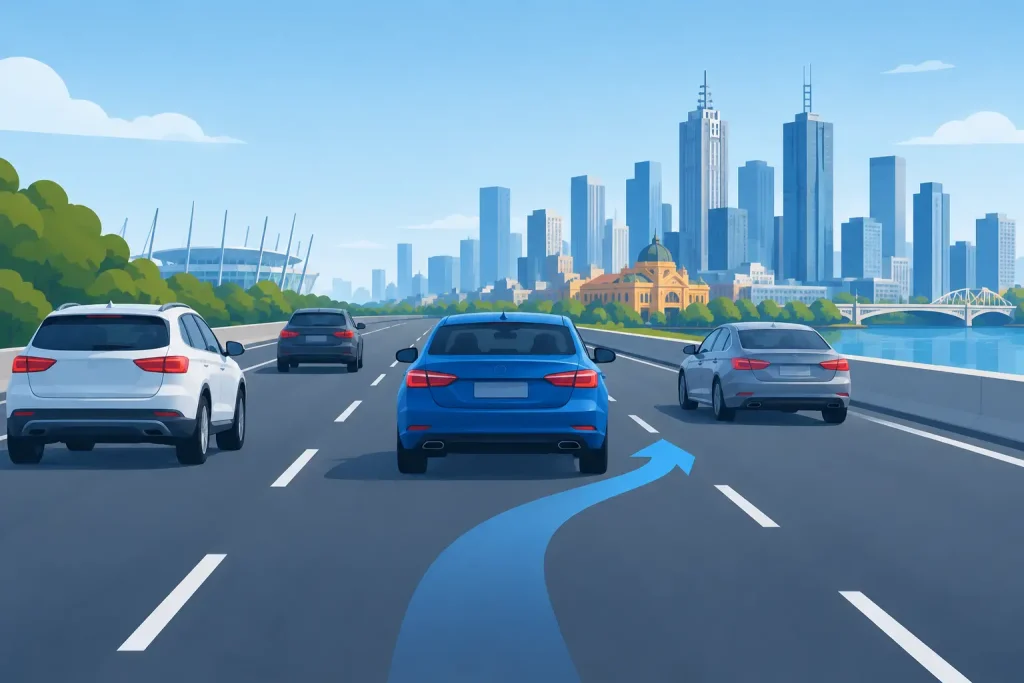
Freeway merging is a related skill, but it needs its own mindset. Use the entry lane to build a speed that matches the freeway traffic as closely as conditions allow. Check mirrors, signal, complete a head check and look for a gap. You are entering an existing traffic flow, so avoid assuming other drivers will make room.
Where a lane ends due to roadworks or merging lanes, read the signs early and merge one vehicle at a time where traffic is flowing. Keep your speed steady where possible and avoid racing ahead to push into a gap. Courtesy helps traffic move, but your first responsibility is safe observation and control.
On multi-lane roads, watch for vehicles moving from more than one lane away. A driver may cross into the same space you intend to use. Your regular mirror checks and forward scanning give you more time to recognise this risk.
Building confidence before your driving test
Confidence does not come from taking bigger gaps or making quick decisions. It comes from repeating the correct process until it becomes calm and consistent. Start practising lane changes on quieter roads, then progress to busier routes with clear guidance from an experienced instructor.
It also helps to practise in different conditions: changing lanes around parked cars, approaching a turn lane, joining busier arterial roads and travelling on roads with several lanes. Each situation teaches you to judge gaps, control speed and stay aware of surrounding traffic.
At Victest Driving School, one-on-one lessons can focus on the parts of lane changing that feel hardest, whether that is head checks, traffic judgement, steering control or test nerves. A patient lesson on familiar western suburbs roads can turn a stressful manoeuvre into a routine part of safe driving.
The next time you need to move across, give yourself time. Check, signal, head check and move only when the gap is genuinely safe. That calm decision-making will protect you long after the driving test is over.