
A driving test can feel very different from a normal lesson. You may know how to steer, brake and park, yet nerves can make simple decisions feel rushed. The goal is not to drive perfectly. It is to show that you can make safe, legal and sensible choices without needing constant help.
For learners in Tarneit, Truganina, Werribee, Hoppers Crossing, Wyndham Vale, Point Cook and Deer Park, preparation works best when it is practical. That means building reliable habits on the same kinds of roads, intersections and shopping-centre car parks you will use after you earn your licence.
What a driving test is really assessing
A practical test assesses more than whether you can complete a reverse parallel park or three-point turn. The licence assessor is looking for safe observation, good vehicle control, lawful speed management and sound judgement around other road users.
They will notice how you approach intersections, whether you scan for pedestrians before turning, and how early you check mirrors before changing position. They will also watch how you respond when something unexpected happens. A car may stop suddenly, a cyclist may appear near the kerb, or traffic may build near a roundabout. Calm, measured decisions matter more than trying to impress anyone.
This is why lessons should not focus only on memorising test routes. Knowing local roads can reduce uncertainty, but real confidence comes from understanding the reason behind each action. If a route changes or traffic is heavier than usual, you still need to drive safely.
Build safe habits before you practise manoeuvres
Many learners spend too much time worrying about parking and not enough time strengthening the habits that support every part of the drive. Good driving starts before the vehicle moves.
Set up your seat so you can press the pedals comfortably and have a clear view of the road. Adjust mirrors properly, fasten your seatbelt and make sure you understand the controls. Before moving away from the kerb, check mirrors, indicate when required and look over your shoulder for vehicles, cyclists and pedestrians.
During the drive, keep your eyes moving. A quick mirror check should become natural before braking, turning, changing lanes, moving off or pulling over. Your head movement should be clear enough that an assessor can see you are checking, but it should never distract you from the road ahead.
Speed control is another area where calm practice pays off. Driving under the limit is not always automatically safe if you are holding up traffic without reason, while driving exactly on the limit may still be unsuitable in rain, near schools or in busy car parks. Read the conditions, watch for signs and leave enough space to react.
Use a simple approach at intersections
At an intersection, give yourself time. Ease off the accelerator early, look well ahead and prepare to stop if needed. When turning, check for pedestrians crossing the road you are entering and for cyclists travelling alongside you. At roundabouts, choose the correct lane early, give way correctly and avoid entering unless there is a safe gap.
Learners often make mistakes when they feel pressured by vehicles behind them. Remember that another driver’s impatience does not change your responsibility. If the gap is not safe, wait. A safe decision is always better than a rushed one.
Common driving test mistakes and how to prevent them
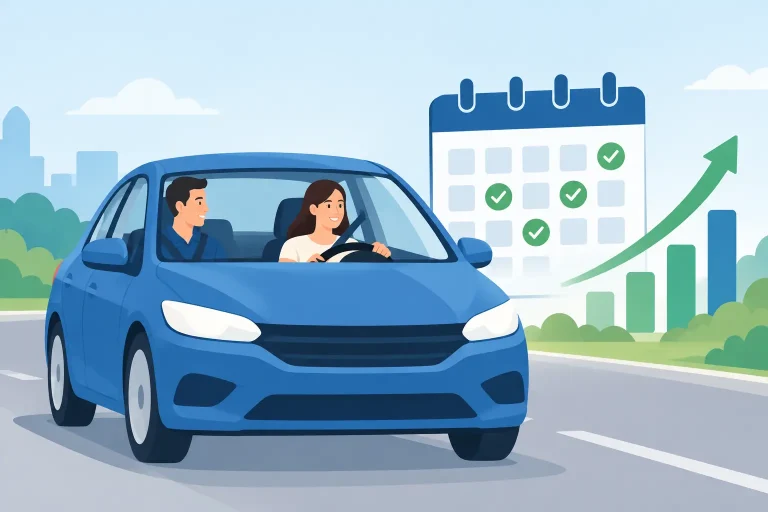
Most errors are not caused by a lack of intelligence or effort. They happen because a learner’s routine breaks down under pressure. The answer is structured practice, feedback and enough repetition for the right actions to feel normal.
One common issue is incomplete observation. A learner may check one mirror but forget a head check before moving out from the kerb or changing lanes. Practise saying the sequence quietly in your mind at first: mirror, indicate, head check, move when safe. With repetition, it becomes smooth rather than mechanical.
Another issue is turning too wide or cutting corners. Slow down before the turn, position the car correctly and steer through the corner with both hands under control. Do not rush to straighten the vehicle until you have entered the new road safely.
Parking mistakes are also common, particularly when learners focus only on the final position. The process matters. Move slowly, observe continuously and correct the car early rather than making large steering changes at the end. If a manoeuvre is not going well, stay calm and follow the safe procedure you have practised with your instructor.
Poor lane discipline can lead to avoidable errors too. Keep the car centred in your lane, plan ahead for turns and do not drift while checking mirrors. On multi-lane roads, read lane markings early so you are not making last-minute changes near an intersection.
Practise for Melbourne’s western suburbs
Local driving conditions can vary quickly. One lesson may include quieter residential streets in Wyndham Vale, while the next involves busy traffic near Werribee, complex roundabouts in Point Cook or changing speeds around Tarneit and Truganina. This variety is useful because it teaches you to adapt.
Residential streets are ideal for refining steering, kerbside stops and hazard awareness. Watch for parked cars, children, bins and vehicles reversing from driveways. Busier roads help you practise gap selection, lane changes, traffic lights and maintaining a safe following distance.
Car parks deserve attention as well. They are low-speed environments, but they require constant observation. People can walk out from between cars, trolleys can roll into traffic and other vehicles may reverse without warning. Drive slowly, cover the brake when appropriate and expect the unexpected.
For international licence holders, the main adjustment is often not basic vehicle control. It can be Victorian road rules, giving way at roundabouts, tram and school-zone awareness, hook turns where relevant, or becoming comfortable with local road markings. Targeted lessons can identify these gaps without making you repeat skills you already have.
Make your mock driving test count
A mock test is most useful when it feels close to the real experience. Begin with a pre-drive check, follow directions independently and include a mix of ordinary driving, intersections, lane changes and manoeuvres. The purpose is not to catch you out. It is to reveal what needs attention while there is still time to improve.
After the mock test, ask for clear feedback. Which observations were missed? Were your turns controlled? Did you hesitate at safe gaps, or move before a gap was safe? Specific feedback gives you a plan for the next lesson.
At Victest Driving School, one-on-one preparation is designed to turn that feedback into practical improvement. With experienced, calm instruction, learners can rehearse the skills they need while building the judgement required for independent driving.
Your driving test day routine
Test day should not be the day you try something new. If possible, have a short warm-up drive beforehand to settle into the vehicle and refresh your observation routine. Arrive with enough time so you are not rushing through paperwork or vehicle checks.
Before you begin, take a slow breath and focus on the next safe action rather than the final result. If you make a small mistake, do not assume the test is over. Continue driving carefully. Many learners lose concentration after a minor error when they may still be performing well overall.
A useful final check before the test is to make sure you have:
- your required licence and booking documents
- suitable footwear that gives you proper pedal control
- a vehicle with working lights, indicators, tyres and enough fuel
- a clear understanding of the vehicle’s demister, wipers and controls
- enough time for a calm pre-drive check and warm-up
The best preparation for a driving test is not trying to look like an experienced driver. It is becoming a safe learner who observes properly, plans ahead and stays composed when the road becomes busy. Those are the habits that help you pass, and more importantly, help you get home safely long after the test is finished.