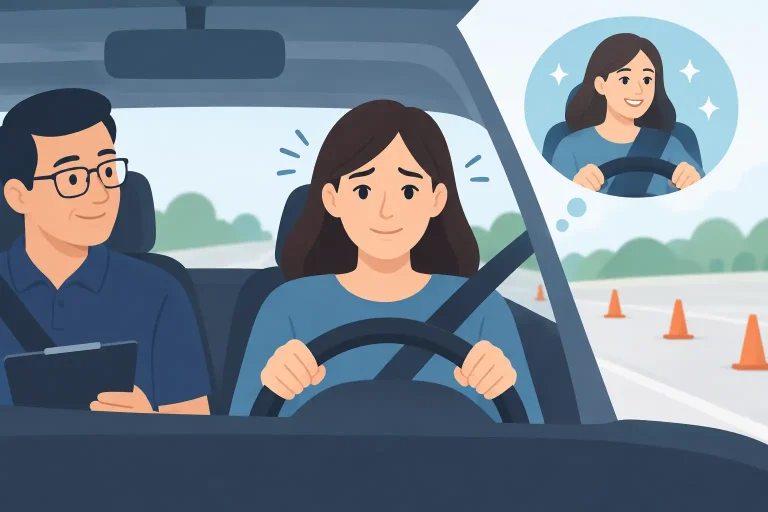
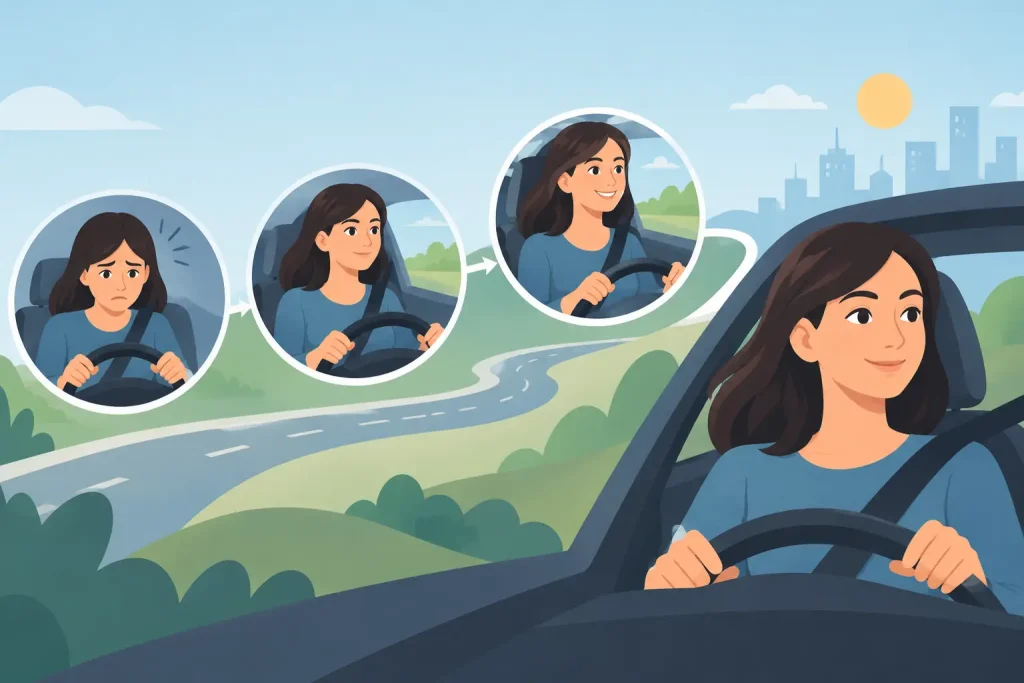
The first time you pull away from the kerb with an instructor beside you, confidence may be the last thing you feel. Your hands might grip the steering wheel too tightly, traffic can seem to come from every direction, and even a simple roundabout may feel overwhelming. A nervous driver confidence journey is not about suddenly becoming fearless. It is about building reliable skills until driving feels calmer, safer and more familiar.
For learners across Melbourne’s western suburbs, nerves are common. Teenagers starting their Ls, adult beginners returning to driving after years away, and international licence holders adapting to Victorian road rules can all feel pressure behind the wheel. The good news is that confidence can be taught, practised and strengthened at a pace that suits you.
What Nervous Driving Really Looks Like
Nervous driving is not always obvious. Some learners become very quiet, brake earlier than needed or hesitate at intersections. Others rush decisions because they want a difficult moment to end quickly. You may know the road rules well but struggle to apply them while checking mirrors, watching pedestrians, managing your speed and listening for directions.
That does not mean you are a bad driver. It means your brain is managing too many new tasks at once. With patient repetition, the basic actions begin to take less effort. This leaves more attention for reading the road ahead and making safe decisions.
A good instructor will not dismiss nerves with phrases such as “just relax”. They will identify what is causing the tension. Is it changing lanes? Busy traffic near Werribee? Parallel parking? Entering a multi-lane roundabout? Once the problem is clear, it can be broken into smaller, manageable steps.
The Nervous Driver Confidence Journey Starts With Control
Before tackling busy roads or test routes, you need to feel in control of the car. This is where structured one-on-one lessons make a genuine difference. Your instructor can adjust the lesson to your experience level instead of rushing you through a fixed plan.
Early sessions should focus on smooth steering, controlled braking, safe acceleration and correct observation. These skills may sound basic, but they shape everything that follows. A learner who can maintain a steady position in the lane and brake smoothly is better prepared to handle traffic lights, school zones and unexpected hazards.
It also helps to learn a consistent routine. Before moving off, check your mirrors, indicate when required, look over your shoulder for blind spots, then move only when it is safe. When turning, use your mirrors, select the right road position, control your speed and look where you want the vehicle to go. Repeating the same safe process reduces uncertainty.
Confidence is not gained by avoiding mistakes. It grows when you make a mistake in a controlled setting, understand why it happened and know what to do differently next time.
Start in the Right Driving Environment
There is a trade-off between practising on challenging roads and becoming overloaded too early. Quiet local streets are useful for beginners because they provide time to concentrate on steering, positioning and basic manoeuvres. However, staying only on empty roads for too long can delay your progress.
As your control improves, lessons should gradually include the situations you will meet every week: busy intersections, lane changes, shopping centre car parks, pedestrian crossings and roundabouts. In suburbs such as Tarneit, Truganina, Hoppers Crossing, Point Cook and Wyndham Vale, road conditions can change quickly between quiet residential streets and major connecting roads. Practising both helps turn confidence into real-world capability.
Replace Guesswork With a Clear Plan
Anxiety becomes stronger when every decision feels like a guess. Clear coaching gives you a process to follow, particularly in the moments that make many learners nervous.
For example, a lane change should not be a quick glance and a sudden movement. It is a planned action: check mirrors, indicate, check the blind spot, assess the gap, move smoothly and cancel the indicator. If the gap is not safe, stay in your lane. Missing a turn is far safer than forcing a lane change.
The same approach applies to roundabouts. Slow down early, choose the correct lane and signal correctly. Give way to vehicles already in the roundabout where required, then enter only when there is a safe gap. Learners often improve quickly when they stop trying to rush and give themselves permission to wait.
Parking needs the same calm structure. Whether you are completing a reverse parallel park, a three-point turn or a kerbside stop, the goal is not speed. It is safe observation, low-speed control and correct positioning. A small correction is normal. Panicking because the first attempt is imperfect often creates more problems than the parking manoeuvre itself.
Practise for Driving, Not Only the Test
Passing the VicRoads practical test matters, but a licence is only the beginning. Teaching only enough to pass can leave a new P-plater unsure when driving alone in rain, peak-hour traffic or an unfamiliar area.
Practical lessons should prepare you for both test day and everyday driving. That includes recognising speed signs, maintaining safe gaps, checking for cyclists, scanning intersections and responding safely when other road users make poor decisions. It also includes the small details that affect a test result, such as complete stops, mirror checks, indicators, speed control and appropriate road position.
Mock tests can be helpful once your core skills are established. They show how it feels to drive with fewer prompts and reveal patterns that may need more work. But a mock test should be used as feedback, not as proof that you are ready or not ready. One anxious drive does not define your ability. Look for consistent safe decisions over several lessons.
At Victest Driving School, lessons can be tailored for nervous learners who need calm instruction as well as practical preparation for local driving conditions. The aim is to help each student understand the reason behind the skill, not simply memorise what to do when an instructor gives a command.
Build Confidence Between Lessons
Lesson time is valuable, but confidence develops faster when you practise safely between sessions. If you have access to a suitable supervising driver and vehicle, agree on one skill for each practice drive. Trying to improve everything at once can make anxiety worse.
You might spend one drive focusing on smooth stops at intersections, then another on left and right turns. On a later drive, practise entering roundabouts or parking in a quieter area. Keep the route realistic and finish before you become exhausted or frustrated. A short, focused 30-minute practice can be more useful than a long drive where nerves take over.
Before starting the car, take a moment to set up properly. Adjust the seat so you can comfortably reach the pedals, set mirrors to minimise blind spots, secure your mobile away from distraction and make sure you know the first part of the route. This simple preparation creates a more settled start.
After the drive, reflect on one thing that went well and one item to practise next time. Avoid saying, “I was terrible.” Be specific instead: “I checked my blind spot well, but I need to slow down earlier before turns.” Specific feedback gives you a path forward.
When Test-Day Nerves Appear
Even capable drivers can feel nervous before a VicRoads test. The pressure is understandable, especially if you have waited a long time for a booking or need a licence for work, study or family responsibilities. The goal is not to remove every nervous feeling. A little adrenaline can help you stay alert.
Prepare early on the day. Bring the documents you need, wear comfortable shoes and arrive with time to settle. A pre-drive check of the vehicle helps you feel organised, while a lesson before the test can refresh your observation routines and speed control.
During the assessment, listen carefully and ask for a direction to be repeated if you did not hear it. Focus on the next safe action, not on what happened five minutes earlier. If you make a minor error, do not assume the test is over. Continue driving safely and let the assessor make the assessment.
Real confidence arrives quietly. It is the moment you notice a hazard early, choose a safe gap without being told, or recover calmly after taking a wrong turn. Keep building those moments one lesson and one safe decision at a time.