

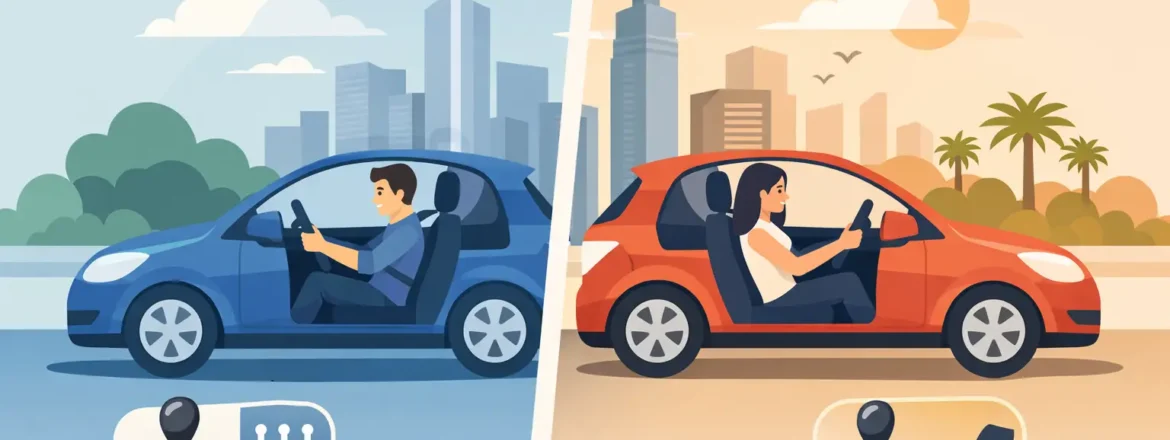
You do not feel the difference between manual vs automatic lessons when you are sitting in the passenger seat. You feel it the moment you take off from the kerb, approach your first busy roundabout, or try to manage steering, mirrors, speed and nerves all at once. For many learners in Melbourne’s west, the right choice comes down to one simple question – do you want the quickest path to confidence, or the broadest set of driving skills?
There is no single right answer for every learner. The best option depends on your confidence level, your licence goals, the type of car you are likely to drive after passing, and how much time you want to spend learning gear control alongside general road skills.
Manual vs automatic lessons: what is the actual difference?
In automatic lessons, the car changes gears for you. That means you can focus more attention on steering, braking, observation, lane position and reading traffic. For many beginners, that lower mental load makes the first few lessons feel less overwhelming.
In manual lessons, you learn to operate the clutch and select gears yourself. That adds another layer of coordination, especially when moving off, stopping on hills, turning at intersections and driving in stop-start traffic. Manual driving can be very rewarding, but it usually takes longer to feel smooth and consistent.
The difference is not just about the car. It changes the pace of learning. An automatic often helps nervous learners settle earlier because there are fewer things to think about at once. A manual can build strong vehicle control, but it asks more from you in the early stages.
Which option is easier for learner drivers?
For most people, automatic lessons are easier at the start. That is especially true for teenagers with little road experience, adult beginners who already feel anxious, and international licence holders adjusting to local roads, rules and test expectations in Victoria.
When you remove clutch control and gear changes, you free up attention for the skills that matter every single drive – mirror checks, hazard awareness, gap selection, speed management and safe decision-making. These are the skills that build confidence in suburbs like Tarneit, Werribee, Hoppers Crossing and Point Cook, where traffic conditions can shift quickly from quiet residential streets to busy main roads.
That does not mean manual is too hard. It means the learning curve is steeper. Some learners enjoy that challenge and pick it up well with patient instruction and regular practice. Others find that manual mistakes, like stalling at lights or rolling on a hill start, increase their stress and slow down progress in other areas.
When manual lessons make sense
Manual lessons can be the better choice if you know you will need to drive a manual car after getting your licence. That might apply if your family car is manual, your work may involve driving different vehicles, or you simply want the flexibility to drive either type in the future.
There is also a practical licensing reason. In Victoria, if you take your driving test in a manual vehicle and pass, you can generally drive both manual and automatic cars. If you take the test in an automatic, your probationary licence will usually only allow you to drive an automatic.
That flexibility matters for some learners more than others. If your household only uses automatic vehicles and you have no plan to drive manual later, the extra effort of manual lessons may not give you much real benefit. But if you want every option open, manual can be worth the investment.
When automatic lessons are the better fit
Automatic lessons are often the best fit for learners who want to become safe, test-ready drivers as efficiently as possible. They suit people who feel nervous in traffic, those returning to driving after a long break, and busy adults who want to learn around work and family commitments.
They are also a smart choice for learners who have struggled in manual lessons before. Sometimes the issue is not driving ability at all. It is simply that too much attention is being used on gears and clutch control, leaving less mental space for observation and judgement.
If your main goal is to pass the VicRoads drive test, build confidence on local roads and drive independently in the car you are actually going to use, automatic lessons can be the more practical path.
Cost, time and value
Some learners assume manual lessons are automatically better value because they teach more skills. That is not always how it works in practice.
A manual lesson may cover more technically, but many learners need extra sessions before they feel consistent with moving off smoothly, changing gears at the right time and handling hills without stress. An automatic learner often reaches test standard sooner because lesson time goes directly into roadcraft, observation and hazard response.
So the real question is not just the lesson price. It is how many lessons you are likely to need to become calm, competent and test-ready. For a confident learner with access to a manual car for regular practice, manual can still be good value. For a nervous learner with limited practice time, automatic may be more efficient overall.
Confidence matters more than ego
Some learners feel pressure to choose manual because they have heard it is the “proper” way to learn. That thinking is outdated. Safe driving is not about proving you can manage a clutch. It is about making good decisions, staying aware, controlling the vehicle smoothly and handling real traffic without panic.
If automatic lessons help you become a safer and more confident driver, that is not taking the easy way out. It is choosing the method that gives you the best chance to learn well.
On the other hand, if you genuinely want to learn manual and are prepared for a slower start, that is a valid choice too. What matters is honest planning. Choose the option that matches your real goals, not somebody else’s opinion.
Manual vs automatic lessons for nervous drivers
This is where the choice often becomes clearer. Nervous drivers usually benefit from reducing pressure in the early stages. Automatic lessons can help you settle into traffic awareness, turning, parking and speed control before adding more complexity.
That calmer start can make a big difference. A learner who feels in control is more likely to absorb feedback, correct mistakes and keep improving from lesson to lesson. A learner who feels overloaded may tense up, rush decisions or avoid practising altogether.
For very anxious learners, the best progress often comes from structured one-on-one lessons with clear instructions, familiar local roads and step-by-step skill building. In that setting, automatic tends to remove one major source of stress.
What about the VicRoads test?
The drive test does not reward unnecessary difficulty. Examiners are looking for safe, consistent driving habits, not extra flair. They want to see observation, proper head checks, lane discipline, speed compliance, smooth control and sound judgement.
Automatic learners can often focus more clearly on those test criteria because they are not dividing attention between traffic decisions and manual operation. Manual learners can absolutely pass as well, but they need to manage both. A stall, rough gear change or poor clutch control will not always mean failure on its own, yet it can affect the overall quality and safety of the drive.
If your test is coming up soon and you are still struggling with manual basics, it may be worth asking whether the current path is helping or holding you back.
How to choose the right lesson type for you
A good decision usually comes from four practical questions. What car will you drive after you pass? How confident are you under pressure? How quickly do you need to be test-ready? And do you want maximum licence flexibility, or the most straightforward route to safe independent driving?
If you are still unsure, the best approach is to talk it through with an experienced instructor who teaches both learners and test candidates across Melbourne’s western suburbs. A calm, honest assessment can save you time, money and a lot of frustration.
At Victest Driving School, this is often where learners get real clarity. Some need the broader skill set of manual. Others do far better in automatic and progress faster once that choice is made. The important thing is not choosing what sounds harder or smarter. It is choosing what helps you become a safe, capable driver on real local roads.
The right lesson type should leave you feeling more in control each week, not more defeated. If your choice supports steady progress, better judgement and genuine confidence behind the wheel, you are already heading in the right direction.