

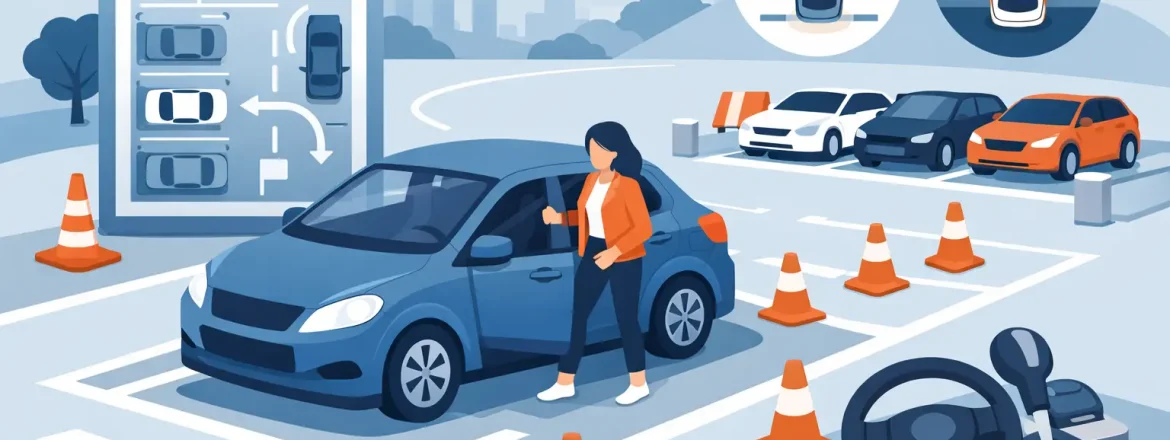
A quiet car park can feel simple until you are behind the wheel, watching the kerb, mirrors, bay lines and other cars all at once. The best ways to practise parking are not about repeating a manoeuvre until you get lucky. They are about building a calm routine that works in different spaces, cars and traffic conditions.
For learner drivers in Melbourne’s western suburbs, parking often becomes stressful because it is left until just before the driving test. Start earlier, practise in stages and give yourself room to make mistakes safely. Confidence comes from knowing what to check, when to steer and how to correct the car without rushing.
Start in a quiet, legal practice area
Your first parking sessions should happen in an empty or lightly used car park, away from busy entrances, pedestrians and trolley bays. School grounds where access is permitted outside school hours, quieter industrial streets and large car parks at off-peak times can provide useful space. Always follow parking signs, give way to pedestrians and avoid practising where you may obstruct other road users.
A learner must have a qualified supervising driver beside them unless they are taking a lesson with an accredited instructor. Choose someone who can stay calm and give clear directions. Too much commentary can make a nervous learner focus on the wrong thing, so agree on one instruction at a time.
Begin with forward parking between wide, empty bays. This lets you learn the relationship between the steering wheel, the car’s position and the painted lines without the pressure of reversing or nearby vehicles. Once you can enter and leave a bay smoothly, make the task more realistic by choosing standard-sized spaces.
Use the same observation routine every time
Good parking starts before the car moves. Whether you are entering a bay, reversing out or parallel parking, use a consistent observation routine. Check your mirrors, indicate early where required, slow down and look around for pedestrians, cyclists, children and vehicles approaching from behind.
When reversing, do not rely only on a reversing camera or sensors. These are helpful aids, but they do not replace direct observation. Turn and look through the rear window where practical, while continuing to scan mirrors for the sides of the vehicle and changing hazards. This is particularly important in busy shopping centre car parks, where people can step out from between parked cars without warning.
Practise saying your routine quietly to yourself at first: mirrors, signal, position, speed, check. It may feel basic, but a repeatable sequence reduces panic when you are being assessed on a VicRoads test route or parking in a busy local area.
Build reference points, then learn to adapt
Reference points can make parking easier for beginners. For example, you may use the position of a bay line in your side mirror or the point where another car appears in your rear window to guide your steering. A qualified instructor can help you find safe, reliable references for the vehicle you are learning in.
However, do not treat a reference point as a magic rule. It can change with your seating position, height, vehicle size, mirror adjustment and the slope of the road. Set your seat and mirrors correctly before you begin. Sit high enough to see clearly over the dashboard, keep a comfortable reach to the pedals and steering wheel, and make sure your mirrors give a useful view along both sides of the car.
As you improve, use reference points as a starting guide rather than something to follow blindly. Look at the whole space. Is the bay angled? Is there a concrete wheel stop? Is the kerb higher than usual? Are the vehicles beside you parked over the lines? Safe drivers adjust to what is actually in front of them.
Practise reverse bay parking before adding pressure
Reverse bay parking gives you better visibility when leaving the space, which is one reason it is a useful everyday skill. Start with two empty bays beside your chosen bay so there is plenty of room. Position the car straight and leave enough space from parked vehicles before beginning the reverse.
Reverse slowly using brake control rather than accelerator pressure. Turn at your planned reference point, check both mirrors and look behind you. If the car begins heading towards one line, make a small correction early. Large, hurried steering changes are usually what place the car across the bay lines.
Do not be embarrassed to stop, move forward and straighten up. A safe correction is better than forcing the car into a poor position. During practice, aim to finish centred in the bay with the vehicle straight, clear of the lines and far enough forward that it does not obstruct the aisle.
Once you are comfortable, practise with cars in the neighbouring bays. This is where careful mirror checks, slow speed and controlled steering matter most. Leave the session if the area becomes too busy. Practising under pressure has value later, but only after the basic movement feels comfortable.
Learn parallel parking as a sequence, not a guess
Parallel parking can look complicated because it involves several checks at once. Break it into a sequence: select a suitable space, signal and position alongside the car in front, check for traffic and pedestrians, reverse slowly while steering into the space, then straighten and adjust while staying clear of both cars and the kerb.
Start by using cones, bins or driveway markers in a quiet street rather than practising immediately between expensive vehicles. This removes the fear of damaging another car and allows you to focus on the car’s angle. Make the gap generous at first, then reduce it as your control improves.
A good result is not simply getting into the space. You should finish reasonably close to the kerb without touching it, leave safe room from the vehicles in front and behind, and avoid stopping where signs or road markings prohibit parking. Check the local conditions too. A manoeuvre that is safe on a quiet residential street may not be suitable near a busy intersection, bus stop, crossing or clearway.
Make speed control your parking advantage
Most parking errors happen because the car is moving faster than the driver can think. Keep the car at walking pace or slower, particularly while reversing. Use smooth brake control and be ready to stop. In an automatic vehicle, gentle brake pressure is often enough to manage creeping speed. In a manual, practise finding the clutch bite point and balancing it with the brake where appropriate.
Avoid turning the steering wheel while the car is completely stationary unless necessary. It can place unnecessary strain on tyres and steering components. More importantly, learn to steer deliberately: hands move, car responds, then you assess. Give the vehicle time to follow the steering input before adding more.
If you lose track of where the car is, stop. Take a breath, check all around and reset. Stopping safely is a sign of control, not failure.
Progress from empty spaces to real-life situations
The most useful parking practice gradually becomes more realistic. After quiet car parks and wide bays, move to narrower spaces, angled parking and busier but manageable locations. Practise reversing out of a bay, as this is often more challenging than entering one. Watch for moving vehicles in the aisle, people loading boots and children walking between cars.
It also helps to practise in different conditions. A wet road affects braking and mirror visibility. Evening practice introduces glare from headlights and reduced visibility. You do not need to seek difficult conditions before you are ready, but avoiding them completely can leave you unprepared for everyday driving.
For driving test preparation, practise parking on roads similar to those around your local test area, but do not try to memorise one exact space or route. Assessors are looking for safe observation, vehicle control, legal positioning and sound judgement. Those skills transfer wherever you drive.
Get focused feedback after each attempt
After every few attempts, stop and discuss one improvement. It could be steering too early, forgetting a head check, approaching too fast or finishing too far from the kerb. Trying to fix five things at once usually makes the next attempt worse.
A professional lesson can be especially helpful if parking is causing anxiety or if family practice has produced conflicting advice. At Victest Driving School, a local instructor can assess your current technique, explain the manoeuvre clearly and tailor practice to the vehicle and roads you will use. For international licence holders, this can also clarify Victorian expectations around observation, signalling and safe road positioning.
Keep a simple note after each session: which manoeuvre you practised, what went well and the one point to work on next time. Ten calm, purposeful attempts are more valuable than an hour of rushed repetition.
The next time you see an empty bay, treat it as a chance to practise your routine rather than a moment to avoid. Slow down, look properly, allow yourself room to correct and let each safe attempt build the confidence you will use long after the test is finished.