

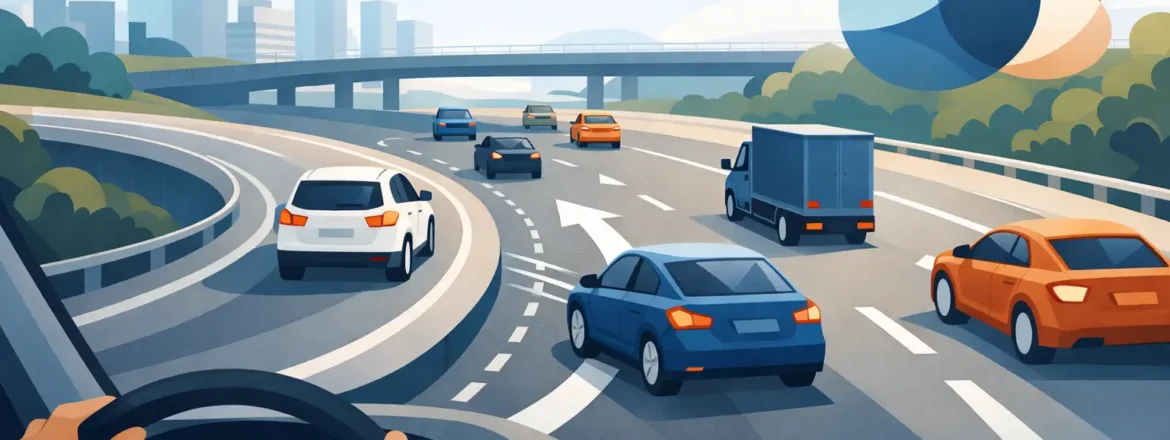
A busy freeway entry can feel like every car is moving faster than you can think. There is traffic beside you, a lane ending ahead, and often a driver behind you waiting for their own gap. For learner drivers, merging onto busy roads is not about forcing your way in or waiting for a perfect opening. It is about reading traffic early, building the right speed and making one calm, well-timed decision.
This skill matters well beyond the driving test. Melbourne’s western suburbs have busy arterial roads, freeway entries and multi-lane routes where confident merging helps traffic flow and keeps everyone safer. With the right routine, it becomes a controlled driving task rather than a stressful rush.
Why merging can feel difficult
When learners feel nervous about merging, they often try to solve every problem at once. They look in the mirror, check the blind spot, watch the car in front, judge the traffic speed and worry about the lane ending. That can lead to hesitation, harsh braking or staring too long at one area.
The answer is not to rush. It is to prepare earlier. A safe merge starts well before the end of the entry lane. Your eyes should be moving between the road ahead, your mirrors and the traffic you plan to join. This gives you time to adjust gradually rather than making a last-second move.
A driver who merges well is predictable. They maintain sensible speed, signal clearly, leave enough room and move into a suitable gap without making other road users brake sharply or change direction. That predictability gives other drivers the best chance to respond safely.
Merging onto busy roads: read the signs and lane markings
Before you focus on the gap, identify what the road is asking you to do. On some roads, a lane ends and you must move across. On others, two lines of traffic merge into one. You may also be entering from an on-ramp, slip lane or a lane that continues further ahead.
Road signs, arrows and lane markings tell you where your vehicle needs to go. Check them early, particularly in unfamiliar areas around Werribee, Tarneit, Truganina or Deer Park, where lane layouts can change quickly near major intersections and freeway access points. If you leave your decision until the final few metres, you limit your choices.
The general merging rule is simple: give way to vehicles already in the lane you are moving into. If road markings or signs give a different instruction, follow them. Do not assume another driver will create a gap just because your lane is ending. Many will help when they can, but your plan must still be safe if they do not.
Keep your vehicle in a useful position
Stay centred in your lane while you approach the merge. Avoid drifting towards the line because you are watching traffic beside you. Keeping the car steady gives you more space and helps you assess gaps accurately.
Use your indicator early enough to communicate your intention, but not so early that it confuses drivers at a nearby turn or lane split. Then use a proper observation routine: check the centre mirror, side mirror and blind spot in the direction you are moving. Your mirrors show a great deal, but they do not show every vehicle, motorcycle or cyclist beside your rear quarter.
Your blind-spot check should be quick. Looking away from the road ahead for too long is unsafe, especially when traffic in your lane may be slowing. Check, return your vision forward, then continue to scan.
Match your speed to the traffic flow
One of the most common merging mistakes is entering too slowly because it feels safer. On a freeway on-ramp or a busy road with fast-moving traffic, a very low speed can actually make it harder to find a safe gap. You may cause vehicles behind to brake, while traffic beside you closes in faster than expected.
Use the length of the entry lane to build speed progressively, while remaining within the posted speed limit and adjusting for weather, traffic and visibility. Your goal is not to speed up blindly. It is to reach a speed that is reasonably close to the traffic flow, so you can fit into a gap smoothly.
At the same time, do not fixate on the vehicle beside you. Look ahead and identify a space, then decide whether you need to ease off slightly to merge behind a vehicle or gently accelerate to merge in front of it. Small, early speed adjustments work far better than sudden braking or acceleration at the end of the lane.
A useful question is: can I enter this gap without making anyone react sharply? If the answer is no, choose another gap. A safe gap needs enough space in front and behind your vehicle, not merely enough room for the car to fit.
Commit only when the gap is safe
Once you have selected a safe gap and completed your observations, steer smoothly into the lane. Keep both hands in a controlled position and avoid a sharp turn. Continue checking ahead as you merge, because traffic conditions can change in seconds.
After entering the lane, cancel the indicator if needed and create a safe following distance. Do not relax too early. The merge is complete only when your vehicle is settled in the lane, travelling at an appropriate speed and leaving room from the traffic ahead.
What to do when there is no suitable gap
Sometimes there simply is not a safe opening. This can happen at peak hour, near roadworks or when heavy traffic is bunched closely together. The right response depends on the road design and the space available.
Keep looking ahead and keep scanning for a new gap. If there is room to continue in your lane safely, use it rather than stopping suddenly. A stopped vehicle at the end of an acceleration lane can be difficult to merge safely, particularly when traffic is moving quickly.
However, never force a merge because you feel pressured by vehicles behind. If you must slow down or stop to avoid a collision, do so smoothly and safely. Your priority is always the space around your car, not another driver’s impatience. Once traffic has passed, reassess and enter only when you have enough room.
It also helps to expect courtesy without relying on it. Some experienced drivers may ease off to make room, and a clear indicator lets them understand your intention. Thank them with a small wave only if it does not distract you from controlling the vehicle.
Habits that make merging safer
Merging is easier when these habits are already part of every lesson and drive:
- Scan well ahead for signs, lane arrows, slowing traffic and the end of your lane.
- Use mirrors regularly, not just at the moment you want to change lanes.
- Check your blind spot before moving sideways.
- Adjust speed early and smoothly rather than braking hard at the last moment.
- Keep a safe following distance so you have time to make decisions.
These habits also help during a VicRoads practical driving test. An assessor is looking for safe observation, good judgement, appropriate speed and vehicle control. They do not expect you to take an unsafe gap to prove confidence. A calm decision to wait for a suitable gap is far better than an abrupt or forced merge.
Practise the skill in stages
For a nervous learner, beginning on a busy freeway can be overwhelming. Start on quieter multi-lane roads where you can practise mirror checks, indicators, blind-spot checks and gentle lane changes with less pressure. Once that routine feels natural, move to busier arterial roads and then freeway entries with an experienced supervising driver or instructor.
Practise at different times of day as well. Traffic around Hoppers Crossing, Point Cook and Wyndham Vale can feel very different outside school and work peaks. Driving in varied conditions teaches you to judge real gaps rather than relying on one familiar route.
A one-on-one lesson can be especially useful if merging is the part of driving that makes you tense. At Victest Driving School, learners can practise local road situations with clear feedback on observation timing, speed control and safer gap selection. Repetition turns the process into a routine you can trust.
The next time the entry lane begins to narrow, give yourself permission to look early, breathe steadily and make one safe choice at a time. Confident merging does not mean never feeling pressure. It means knowing that safety and good judgement come first, even when the road is busy.