

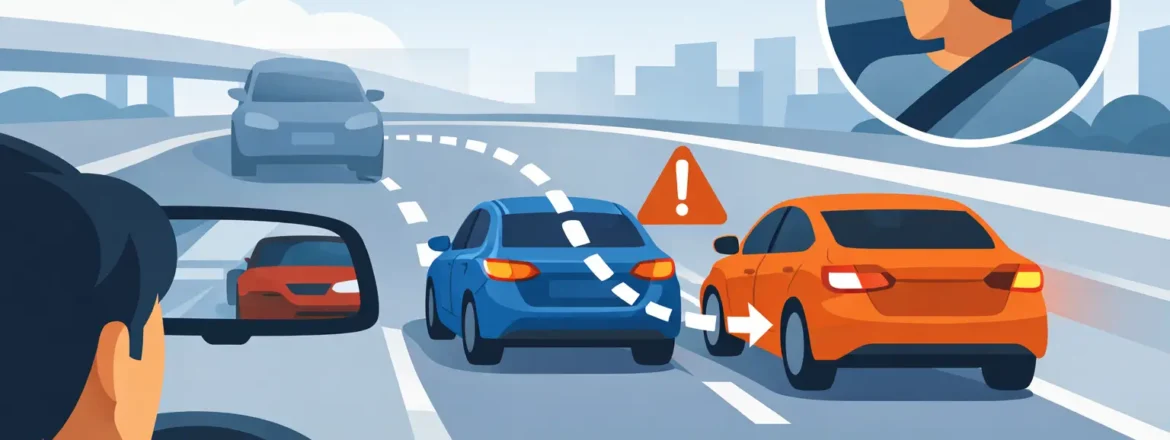
A lane change can take only a few seconds, but it asks you to assess several things at once: traffic behind you, vehicles beside you, the space ahead, your speed and the behaviour of other drivers. Many lane change observation mistakes happen when learners rush this process or treat a mirror check as a substitute for looking properly. On busy roads around Tarneit, Werribee, Hoppers Crossing and Point Cook, a calm routine gives you more time to make a safe decision.
For a VicRoads driving test, your assessor needs to see that you observe carefully and make safe choices. More importantly, this routine protects you long after the test is over. A good lane change is not about moving quickly into a gap. It is about recognising whether the gap is genuinely safe, then moving smoothly and predictably.
Why lane change observation mistakes matter
A lane is not empty simply because it looks clear in the centre mirror. Mirrors have blind spots, and another car, motorcycle or cyclist can be travelling beside the rear corner of your vehicle without appearing clearly in either mirror. This is especially relevant near freeway entries and exits, multi-lane roundabouts, shopping precincts and roads where traffic queues suddenly.
Observation errors can also create pressure for other drivers. If you begin moving over without enough room, a driver in the next lane may need to brake or steer away. Even when there is no collision, the change can be marked as unsafe in a driving test.
The answer is not to stare at mirrors for a long time. Looking away from the road ahead for too long can create another hazard. Instead, build short, purposeful checks into one repeatable sequence.
The observation routine for a safe lane change
Before changing lanes, first look well ahead and decide whether you actually need to move. Perhaps your lane continues, or perhaps the turn is far enough away that there is no reason to force your way into another lane now. Planning early reduces rushed decisions.
When a lane change is needed, check your rear-view mirror and side mirror to understand what is happening behind and beside you. Signal in time to give other road users a clear warning of your intention. Then check again and complete a quick head check towards the blind spot on the side you are moving to.
Only start moving across when the lane is clear and there is a safe gap. Keep your speed steady where possible, steer gradually and avoid drifting across more than one lane at a time. Once you are fully established in the new lane, cancel the indicator if it has not cancelled itself.
The order matters because traffic can change quickly. A gap that looked safe before you indicated may no longer be safe after a car behind has accelerated. Your final mirror and blind-spot check are your last confirmation before the vehicle moves sideways.
The head check should be brief but obvious
A head check is a quick glance over the shoulder towards the blind spot. It should not be a long turn that takes your attention from the road ahead. Keep both hands controlled on the steering wheel and return your eyes forward immediately.
Learners sometimes make the head check too early, then begin changing lanes several seconds later. On a driving test, that can suggest the observation was not current. In normal driving, it has the same problem: a motorcycle can enter your blind spot after you have looked. Make the head check immediately before you start moving across.
Common lane change observation mistakes
Relying on mirrors alone
This is one of the most common errors, particularly for drivers who are focused on looking composed during a test. Side mirrors provide useful information, but they do not cover every angle. A vehicle travelling close to your rear quarter can disappear from view.
Use mirrors to build the bigger picture, then use the head check to confirm the blind spot is clear. Adjusted mirrors help, but they do not remove the need for this final check.
Indicating and moving at the same time
An indicator communicates intention. It does not give you permission to move, and it does not make other vehicles slow down or create a gap. Moving as soon as the indicator comes on gives drivers beside or behind you little warning.
Signal early enough for others to understand what you plan to do, then recheck the lane. If no suitable gap appears, keep your lane and continue safely. Waiting is always better than forcing the manoeuvre.
Looking without assessing the gap
Some learners perform every required observation but still misjudge the available space. They see a car in the adjacent lane, yet move across because it appears to be slightly behind them. The key question is not only where that vehicle is now, but how quickly it is closing and whether your move would make it brake or alter course.
A safe gap depends on speed, traffic flow and road conditions. On a wet road, at higher speeds or when driving beside a large truck or bus, allow more space. If you are unsure, do not change lanes yet.
Forgetting to check for motorcycles, cyclists and smaller vehicles
Smaller road users can be harder to spot, particularly in low light, rain or heavy traffic. A motorcycle may approach quickly through gaps in traffic, while a cyclist can be travelling near the kerb or in a marked bike lane.
Do not assume the lane is clear because you cannot see a full-sized car. Make your mirror checks deliberate and complete the blind-spot check every time you move sideways, including when moving around a parked vehicle.
Turning the wheel before the final check
A slight steering movement can make the vehicle drift into the next lane before you have confirmed it is safe. This often happens when a learner is nervous or trying to complete the manoeuvre before an upcoming turn.
Keep the vehicle centred in your lane until your observations are complete. Check, decide, then steer. This simple pause makes the sequence safer and easier for an assessor to recognise.
Changing lanes too close to an intersection or turn
Late planning causes many avoidable problems. If your turn is approaching and the lane beside you is busy, there may not be a safe opportunity to move across. Cutting in at the last moment, stopping unexpectedly or turning from the wrong lane can all create risk.
Read signs early and position your vehicle well before the intersection. If you miss a turn, continue safely and find another route. In a driving test, taking a wrong turn safely is far better than making an unsafe correction.
How to practise without building bad habits
Start on quieter multi-lane roads with an instructor who can guide your timing and help you identify safe gaps. Practise the sequence at lower speeds first, then apply it in heavier traffic, near freeway ramps and on roads with more complex lane markings.
It also helps to say the process quietly to yourself while learning: mirror, signal, mirror, head check, move when safe. This is not something you need to say forever, but it can prevent your observations from becoming rushed or random. With practice, the routine becomes natural rather than mechanical.
A good lesson should also cover situations where you should not change lanes. Traffic may be too close, the road markings may prevent it, or there may be no practical reason to move. Safe driving is not measured by how many manoeuvres you complete. It is measured by the judgement behind them.
At Victest Driving School, practical one-on-one lessons focus on helping learners recognise what they can see, what they cannot see and when it is best to wait. That support can be especially valuable for nervous drivers and international licence holders adjusting to Melbourne traffic conditions.
Stay patient when the gap is not there
The safest lane change is sometimes the one you decide not to make. Keep a safe following distance, plan ahead and give yourself permission to wait for a proper gap. When your observation routine is calm and consistent, lane changes become less stressful, your driving looks more confident and the people around you have more time to respond safely.