

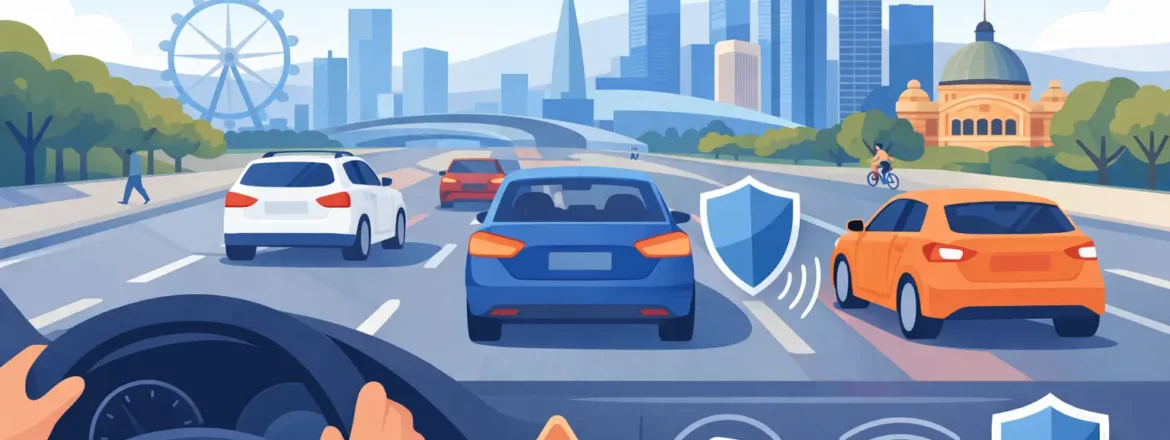
A car changes lanes without indicating on the Princes Freeway. A child steps out from between parked cars near a school zone. Traffic suddenly stops at a busy Hoppers Crossing intersection. These are not rare surprises for Melbourne drivers. The top defensive driving habits help you spot risks early, make calmer decisions and give yourself enough time and space to respond safely.
Defensive driving is not about expecting every other driver to make a mistake. It is about accepting that traffic is unpredictable and driving in a way that protects you, your passengers, cyclists, pedestrians and other road users. For learner drivers, these habits also build the steady judgement VicRoads assessors want to see during a practical driving test.
What defensive driving looks like in real traffic
A defensive driver is alert, patient and prepared. They do not follow too closely, rush yellow lights or assume another road user has seen them. Instead, they keep scanning, manage their speed and leave room for the unexpected.
This approach matters just as much on a quiet Tarneit street as it does on a congested road through Werribee or Point Cook. A quiet street may have children, pets, parked cars and vehicles reversing from driveways. A busy road may have impatient drivers, changing lanes and sudden braking. The setting changes, but the habit remains the same: look ahead, plan early and avoid putting yourself in a position where a last-second reaction is your only option.
Top defensive driving habits to practise every lesson
Keep a safe following gap
The space in front of your vehicle is one of your best safety tools. In normal dry conditions, use at least a three-second gap from the vehicle ahead. Pick a fixed object such as a signpost or power pole. When the car in front passes it, count: “one thousand and one, one thousand and two, one thousand and three.” You should reach the same point after the count.
Increase that gap in rain, low light, heavy traffic or when following a large vehicle. Wet roads reduce grip, while vans, utes and trucks can block your view of what is happening ahead. A larger gap gives you time to brake progressively rather than sharply. It also makes your driving smoother, which is valuable in a driving test and in everyday traffic.
Scan well beyond the car in front
New drivers often look only at the rear of the vehicle ahead. This makes it harder to recognise slowing traffic until it is too late. Train your eyes to look well ahead, then return your attention to what is immediately around you.
Watch brake lights several cars ahead, traffic signals, intersections, pedestrians near crossings and vehicles waiting to turn. On suburban roads, look for gaps between parked cars, movement near driveways and footballs or children near the kerb. On freeways, check for brake-light waves, merging traffic and vehicles drifting within their lane.
Good scanning is active, not a fixed stare. Your vision should move between the road ahead, mirrors, side areas and potential hazards. The aim is to identify what could affect your path before it becomes urgent.
Use mirrors with purpose
Mirror checks are more than a test requirement. They tell you whether you have space to slow down, turn, change lanes or move around an obstacle without creating a risk behind you.
Check your rear-view mirror regularly while driving, particularly before braking, reducing speed or turning. Before changing lanes, use the full sequence: mirror, indicator, head check, then move only when it is safe. The head check is essential because mirrors cannot show every blind spot.
Do not make mirror checks so long that you stop watching the road ahead. A quick, deliberate glance is enough. With practice, you will develop a rhythm that keeps you aware of traffic around the whole vehicle.
Control speed for the conditions, not just the sign
The speed limit is the maximum permitted speed when conditions are suitable. It is not always the safest speed. Heavy rain, glare from a low sun, narrow streets, roadworks and crowded shopping areas may all require you to travel below the posted limit.
In Melbourne’s western suburbs, conditions can change quickly. You may leave a clear main road and turn into a street with parked cars, speed humps and limited visibility. Ease off the accelerator early rather than braking hard at the last moment.
Speed control also means keeping your speed steady. Avoid creeping above the limit on downhill roads and avoid unnecessary bursts of acceleration between lights. Calm, controlled speed shows good judgement and gives you more time to see hazards.
Create space around your vehicle
A defensive driver does not only manage the gap ahead. They try to maintain a safe buffer on both sides and behind where possible. Avoid driving alongside another vehicle for long periods, especially near freeway exits or merging lanes. If the vehicle beside you moves unexpectedly, there may be nowhere to go.
When passing parked cars, leave a sensible clearance while staying safely within your lane. Be especially cautious around large vehicles, as their blind spots are bigger and they need more room to turn. At traffic lights, stop far enough behind the car ahead that you can see its rear tyres touching the road. This gives you room if traffic shifts or the vehicle rolls back.
You cannot always choose how much space is behind you. If someone is following closely, avoid reacting with sudden braking. Increase your gap ahead, brake gently and, when safe, allow them to pass.
Expect mistakes at intersections
Intersections demand more attention than almost any other part of a drive. Even when you have a green light or right of way, check that cross traffic is stopping. A green light gives permission to proceed, but it does not guarantee that every driver will obey it.
Before entering an intersection, look for vehicles turning across your path, cyclists travelling beside traffic and pedestrians stepping onto crossings. At roundabouts, slow early, assess who is already circulating and indicate correctly when exiting. Never enter simply because the car behind you appears impatient.
When turning right across traffic, wait for a safe gap rather than relying on an oncoming driver to slow down. If your view is blocked by a larger vehicle, wait until you can see clearly. A few extra seconds are always better than a risky guess.
Stay calm when another driver is unpredictable
Someone may cut in front of you, fail to indicate or sit too close behind your car. Your response matters more than their behaviour. Horn use, angry gestures and rushed manoeuvres can distract you from the road and escalate an already unsafe situation.
Take a breath, keep your hands steady and focus on creating room. Let an aggressive driver go ahead if you can do so safely. Do not compete for a lane or try to teach someone a lesson. Defensive driving is about getting home safely, not proving a point.
This is particularly helpful for nervous learners. You do not need to control every driver around you. You only need to keep making safe, legal and considered choices.
Remove distractions before moving off
Many dangerous situations begin before the car has even left the kerb. Set up your seat, mirrors, route, air-conditioning and music before you start driving. Put your mobile away or use a lawful hands-free setup only when necessary. Even a quick glance at a notification can mean travelling a significant distance without properly seeing the road.
If you are feeling upset, overtired or rushed, give yourself a moment before leaving. Fatigue and stress reduce concentration and make it harder to judge speed and gaps. If you are already driving and need to deal with a call, directions or a passenger issue, pull over safely first.
Turning habits into confident driving
The best way to build defensive driving skills is through repetition in different conditions. Start by choosing one focus for each drive. For example, practise maintaining a three-second gap on a main road, then focus on mirror routines during lane changes, or on early speed reduction near busy intersections.
A good instructor can identify the habits you may not notice yourself, such as late braking, missed mirror checks or looking too close to the bonnet. At Victest Driving School, lessons are designed to build these real-world skills alongside practical test preparation, so students can feel prepared well beyond test day.
Do not expect perfection immediately. Even experienced drivers keep improving when they drive with awareness and patience. Each safe decision gives you more control, more confidence and more time to handle whatever appears around the next corner.