

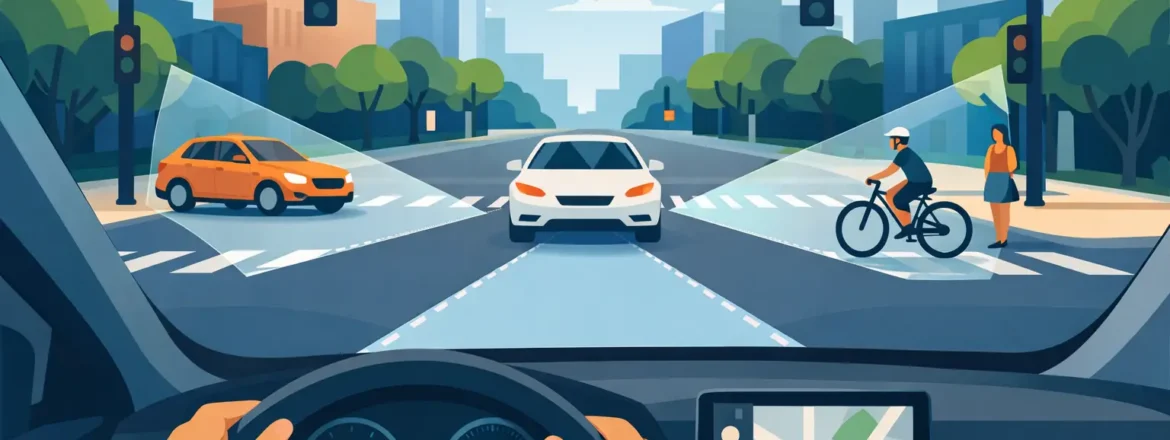
A learner can have good steering and smooth braking, then lose marks or create a dangerous moment simply by looking too late at an intersection. Learning how to scan intersections properly is not about making quick head movements for a driving test. It is about noticing hazards early enough to slow down, make a safe decision and protect the people around you.
In Melbourne’s western suburbs, intersections can change quickly. A quiet residential street in Tarneit may have a car reversing from a driveway, while a busy junction in Werribee or Hoppers Crossing may include cyclists, pedestrians, buses and several lanes of traffic. A calm, repeated scanning routine gives you time to respond instead of react.
Start Scanning Before You Reach the Intersection
The biggest mistake is waiting until the give way line, stop line or corner to look. By then, your choices are limited. Start assessing the intersection well before you arrive, ideally as soon as you can clearly see its layout and traffic conditions.
First, identify what controls the intersection. Are there traffic lights, stop signs, give way signs, a roundabout, turning arrows, marked lanes or no signs at all? Your approach changes depending on the control in place. For example, a green traffic light does not mean you can stop observing. A vehicle may still turn across your path, a pedestrian may step onto the crossing, or traffic ahead may be stopped beyond the intersection.
As you approach, check your centre mirror to understand what is happening behind you, especially if you need to reduce speed. Then look ahead and scan broadly rather than staring only at the vehicle in front. Notice traffic flow, gaps, parked vehicles, roadworks and any person near the kerb who could enter the road.
Good scanning is active. Your eyes should move between the road ahead, mirrors, side areas and the intersection itself. Keep the car travelling smoothly while you do it. There is no benefit in looking everywhere if your speed is too high for the situation.
How to Scan Intersections Properly: A Simple Routine
A reliable routine helps nervous learners stay organised under pressure. Use this sequence as you approach every intersection, then adjust it to suit the road conditions.
- Read the signs and road markings. Check whether you must stop, give way, follow a lane arrow or prepare for lights. Look early for speed signs, pedestrian crossings and bicycle lanes.
- Check ahead and both sides. Scan left, right and ahead for moving vehicles, pedestrians, cyclists, scooters and vehicles waiting to turn. At an open intersection, do not assume another driver has seen you.
- Check your mirrors before changing speed or position. Use the centre mirror before slowing, then side mirrors when preparing to turn or move lanes. If turning or merging, complete the appropriate head check for blind spots.
- Choose a safe speed and position. Ease off the accelerator early and brake progressively if needed. Position your car correctly in the lane before the intersection, not at the last second.
- Look again before entering. Conditions can change in moments. Make a final check in the direction of the main risk before you move through, turn or enter a gap.
This routine is not meant to be robotic. With practice, it becomes a natural flow of observations that lets you keep your attention on the most relevant hazards.
Scanning at Different Types of Intersections
Traffic lights and pedestrian crossings
At traffic lights, look well ahead to see the signal colour and the traffic queue beyond the lights. If vehicles are backed up through the intersection, do not enter unless there is enough room to clear it. Blocking an intersection can create risk for cross traffic and emergency vehicles.
When your light turns green, pause briefly to scan for late-moving traffic before proceeding. This is especially important after the light has changed from red, when another road user may try to clear the intersection. If you are turning, check the crossing area carefully. Pedestrians may have a green walk signal, and cyclists may be travelling beside traffic or using a crossing.
Give way and stop sign intersections
At a give way sign, reduce speed early enough to assess the traffic properly. You may not need to stop when the road is clearly clear, but you must be prepared to stop. Look into every road you could conflict with, including for a vehicle hidden by parked cars, shrubs or a large ute.
At a stop sign, come to a complete stop at the stop line. If there is no line, stop before entering the intersection where you can see safely without blocking the footpath or road. After stopping, scan left, right and left again where appropriate, while also checking for pedestrians and cyclists. A full stop is essential, but the observation after the stop is what makes the decision safe.
Uncontrolled intersections
An intersection without signs or lights needs extra care because every driver is relying on the road rules and good judgement. In Victoria, you generally give way to vehicles approaching from your right at an uncontrolled intersection. That does not remove the need to scan both ways. Another driver may be travelling too fast, may not understand the rule, or may be obscured until late.
Approach slowly enough to stop if necessary. Residential streets often create restricted vision through parked cars, bins, trees and fences. Treat limited vision as a hazard, not a reason to edge out quickly.
Turning left or right
Turning is where observation needs to become more specific. Before a left turn, check mirrors, indicate in time and look for cyclists travelling along your left side. Then scan the crossing for pedestrians before you turn. Do not cut the corner, and do not focus so heavily on the turn that you miss someone crossing.
For a right turn, position correctly, indicate and check mirrors as you prepare. At a green light without a turning arrow, give way to oncoming traffic and pedestrians crossing the road you are entering. Keep scanning the path of your turn, the oncoming lane and the crossing area. If your view is blocked by a larger vehicle, wait until you can see clearly rather than guessing that the gap is safe.
Use Your Head Checks at the Right Time
Mirror checks show you a lot, but they do not show everything. A head check is a quick glance over your shoulder to check the blind spot before moving sideways. Use it when changing lanes, merging, pulling away from the kerb, moving around a parked vehicle or turning where a cyclist could be alongside you.
Do not turn your head for so long that you stop watching the road ahead. The aim is a brief, purposeful check after your mirrors, not an extended look. Your instructor may assess whether your head checks are visible during a VicRoads driving test, but their real value is preventing a collision with a road user you did not see in the mirror.
Avoid the Habits That Reduce Your View
Many scanning errors come from rushing. Learners may follow the car ahead too closely, approach too fast or concentrate only on finding a gap. Those habits narrow your view and make it harder to notice developing hazards.
Avoid creeping into an intersection when your view is poor unless you are moving slowly and carefully to improve sight lines. Avoid relying on another driver’s indicator alone, too. Indicators can be left on accidentally, and a vehicle that appears to be turning may continue straight ahead.
Also watch for visual distractions. A passenger talking, a mobile notification or concern about the cars waiting behind you can pull your attention away from the decision in front of you. It is better to wait for a clearly safe gap than move because you feel pressured.
Build the Skill Before Test Day
Intersection scanning improves through repetition in real traffic, with feedback on what you saw and what you missed. Start on quieter streets where you can practise the approach routine without heavy pressure. Then progress to busier roads, multi-lane intersections, roundabouts and test-area routes.
During lessons, say your observations quietly if it helps: “give way sign, pedestrian on the left, car approaching from the right, clear gap.” This can slow down racing thoughts and make your decision-making clearer. As confidence grows, the commentary becomes internal, but the scanning habit remains.
A patient instructor can also help you separate safe caution from hesitation. You do not need to rush into every small gap, but you do need to recognise a safe opportunity and proceed decisively. Victest Driving School focuses on this practical judgement so learners can handle both VicRoads test conditions and everyday driving with greater confidence.
The next time you approach an intersection, give yourself time to look early, look broadly and look again before moving. That small routine can turn a stressful junction into a controlled, confident decision.