A car waiting at a side street, a cyclist approaching from behind, brake lights several vehicles ahead – these are the moments that matter in the Hazard Perception Test. This guide to Victorian hazard perception explains what the test is really assessing: not fast clicking, but your ability to recognise a situation before it becomes dangerous.
For many learner drivers in Melbourne’s western suburbs, the test feels unfamiliar because you are watching traffic rather than controlling the car. The same safe-driving habits still apply. Look well ahead, read the road environment and expect other road users to make mistakes.
What the Victorian Hazard Perception Test assesses
The Victorian Hazard Perception Test uses video clips of real driving situations. You watch from the driver’s viewpoint and respond when you identify a developing hazard. A developing hazard is not simply something you can see. It is a person, vehicle or situation that is likely to require you to slow down, change position or take another action to stay safe.
For example, a parked car is not automatically a hazard. It becomes one if there is a person near the driver’s door, children playing nearby, or a vehicle pulling out into your path. Likewise, a pedestrian standing safely on the footpath may not require a response yet. If they turn towards the road, look for a gap or move towards a crossing, the risk is developing.
The test checks whether you respond at an appropriate time. Clicking too early can mean you have reacted before there is evidence of risk. Clicking too late may mean that, in a real car, you would not have enough space to brake or respond safely.
A guide to Victorian hazard perception: what to look for
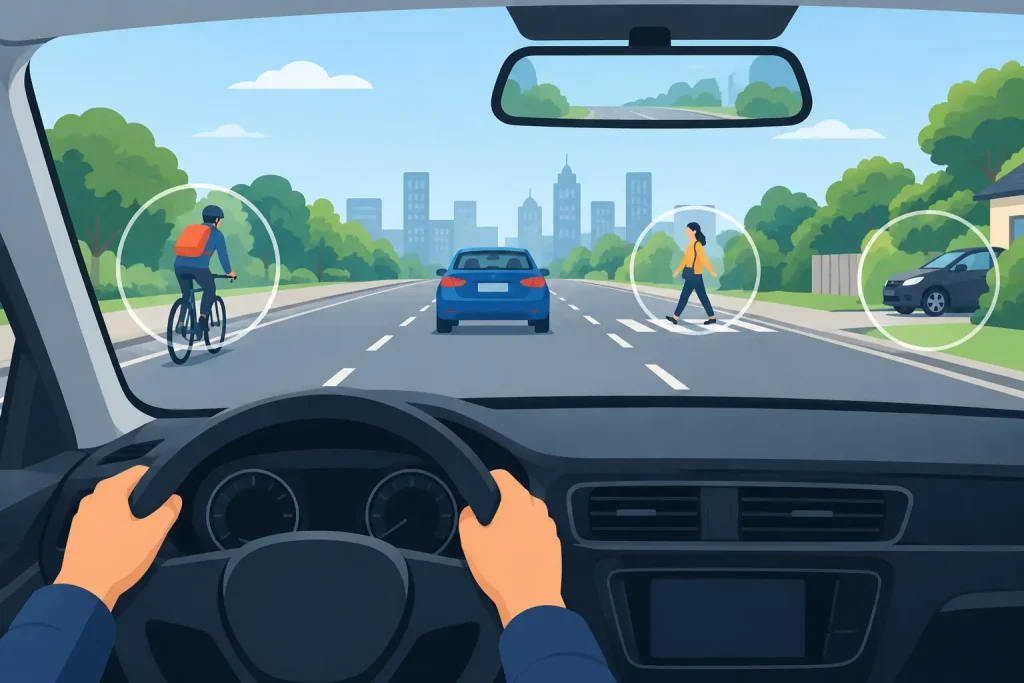
The strongest test candidates do not stare only at the car directly in front. They scan ahead and keep noticing changes at the sides of the road. Every clip has clues, and the key is putting those clues together.
Watch the traffic flow first. If a vehicle ahead is slowing, moving within its lane or approaching a queue, consider why. Brake lights several cars ahead often signal a hazard before the vehicle in front of you has begun braking. At intersections, look at vehicles waiting to turn, cars edging out of driveways and gaps in oncoming traffic that may encourage another driver to move.
Then read the road edges. Pedestrians near crossings, children around parked cars, cyclists, buses pulling away, delivery vehicles and cars reversing from parking bays all deserve attention. In busy suburban areas such as Werribee, Tarneit, Truganina and Hoppers Crossing, hazards often emerge from shopping strips, school zones, roundabouts and side streets rather than appearing directly ahead.
Road conditions also change the safe response. Rain, glare, wet leaves, a narrow lane or reduced visibility may mean a situation becomes hazardous sooner. A driver who is turning across your path is a concern in any weather, but reduced grip gives you less room for error.
Recognise the difference between seeing and predicting
A common mistake is clicking every time a vehicle, pedestrian or bicycle appears. The test is looking for judgement, not nervous reactions. Ask yourself: “Could this situation affect my path or speed in the next few seconds?”
A car travelling normally in an adjacent lane may not need a response. If it begins drifting towards a lane line, approaches a merge point or indicates to move into your lane, that is different. You are responding to the likelihood that its movement will affect you.
This is why hazard perception is closely connected to observation skills you use in driving lessons. Good mirror checks, keeping a safe following distance and looking through traffic all give you extra time to identify a changing situation.
When should you click?
There is no benefit in trying to guess a fixed point in every video. Click when you reasonably believe you may need to take action because the risk is developing. Depending on the clip, that action may be braking, easing off the accelerator, preparing to give way or changing your position safely.
If the situation continues to develop after your first response, it may be appropriate to click again. For instance, a pedestrian might step off the kerb after you have already noticed they are about to cross. However, avoid repeated random clicking. The purpose is to show that you have identified a genuine change, not to cover every possible answer.
The best mindset is calm and alert. Do not wait until a collision looks certain. By that point, a safe driver may already have needed to slow down. At the same time, do not react to an ordinary road scene without a sign that it is likely to affect you.
Common hazards that catch learners out
Turning vehicles are one of the biggest areas to practise. A vehicle waiting at an intersection may turn across your path, especially if it has a gap in oncoming traffic. Watch its wheels, position and indicator, but remember that not every driver indicates correctly.
Parked vehicles also need careful attention. A car may pull away, reverse, open a door or hide a pedestrian. When travelling through residential streets, allow for people walking between cars, children chasing a ball and vehicles leaving driveways.
Roundabouts need prediction rather than assumption. Another driver may enter without giving way, leave suddenly, or choose an unexpected lane. Keep looking at the approach speed and direction of other vehicles instead of assuming they will follow the rules perfectly.
On higher-speed roads, the hazard may be further away. Congestion, merging traffic, roadworks and a vehicle slowing to turn can take longer to recognise but require earlier action. This is where looking well beyond the bonnet becomes especially valuable.
Practise the skill away from the screen
Online practice can help you become familiar with the test format, but real driving is where hazard awareness becomes natural. During supervised driving, talk through what you can see ahead. You might say, “That bus is indicating, so I may need to slow,” or “The car at the side street is creeping forward, so I am ready to brake.”
This commentary helps nervous learners turn a vague feeling of danger into a clear decision. It also shows where your attention is going. If you consistently notice hazards only after your supervising driver points them out, focus on extending your view further up the road and checking side areas more regularly.
A qualified instructor can make this practice more specific. At Victest Driving School, lessons can include guided hazard scanning on local roads, with practical feedback on where to look, when to ease off and how to leave a safer buffer. That preparation supports both the hazard perception assessment and the judgement needed on your Ps.
Prepare properly before test day
Do not leave hazard perception practice until the night before your assessment. Short, regular sessions are usually more useful than trying to memorise videos in one sitting. After each practice clip, think about what made the hazard develop. Was it speed, position, another road user’s body language, a blocked view or changing traffic conditions?
Make sure you understand the test instructions on the day and take your time to settle before beginning. Read each scenario carefully. You are not expected to predict every possible danger on the road. You are showing that you can recognise the risks that are becoming relevant to your driving.
If you are an international licence holder, avoid relying only on driving habits from overseas. Victorian roads may have different intersection layouts, tram and cyclist activity, school-zone conditions and give-way expectations. The safest approach is always to observe the situation in front of you and respond to what is happening, not what you expect drivers to do.
Hazard perception improves with patient observation. Each time you drive, give yourself a little more time by looking ahead, scanning the road edges and asking what could change next. That habit will help you approach the test with more confidence and keep making safer decisions long after you receive your licence.