

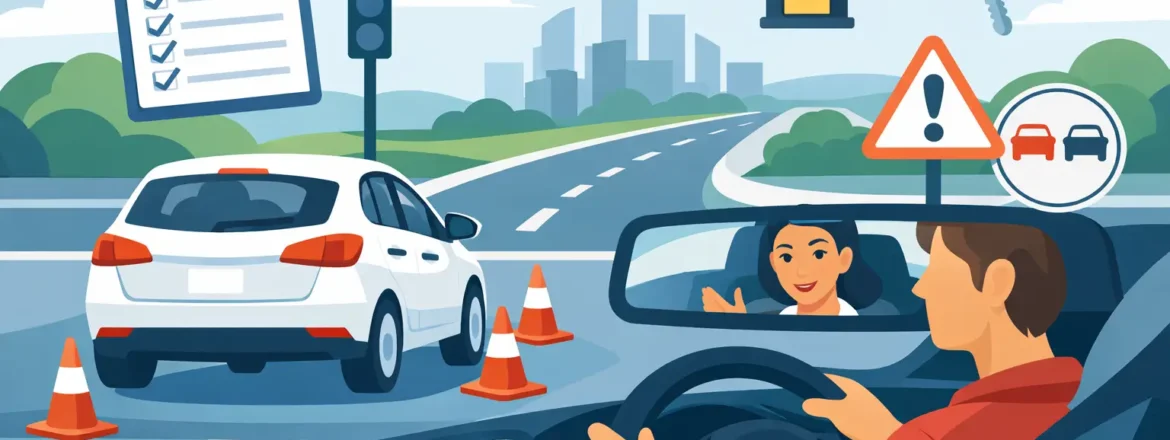
A learner who checks mirrors before every change of direction, manages their speed early and stays calm after a small mistake is already building the habits that matter most. The best learner driver habits are not about looking perfect for one lesson or one VicRoads drive test. They help you make safe decisions when traffic builds up near Werribee, a roundabout feels busy in Tarneit, or rain reduces visibility on the way home.
Good driving is built through repetition with purpose. Whether you are starting from scratch, returning to driving after a long break or converting an overseas licence, the goal is the same: become a safe, confident and responsible driver who can handle real roads independently.
10 best learner driver habits to build early
1. Set up the car before moving off
Many driving errors begin before the vehicle has even moved. Take a moment to adjust your seat, mirrors and steering wheel position so you can comfortably reach the pedals and see clearly. Fasten your seatbelt, make sure the handbrake and gear selection are understood, and check that nothing is loose around the pedals.
This routine should become automatic. A proper pre-drive check helps you feel settled and gives you better control from the first metre. It also shows that you are ready to drive safely rather than rushing because someone is waiting behind you.
2. Look well ahead, not just at the car in front
New drivers often focus too closely on the vehicle ahead. That makes braking feel sudden and leaves little time to plan. Train yourself to scan further down the road, then bring your attention back to nearby hazards such as pedestrians, parked cars and vehicles entering from side streets.
Looking ahead gives you time to ease off the accelerator instead of braking sharply. You may spot a queue at traffic lights, a school crossing, or a driver preparing to turn before it becomes an urgent problem. On unfamiliar Melbourne roads, this habit is especially valuable because lane directions and traffic conditions can change quickly.
3. Use a consistent mirror routine
Mirrors are not a quick glance performed only when an instructor reminds you. Make them part of your driving rhythm. Check them regularly to understand what is behind and beside you, then use the correct mirror and head check before changing lanes, moving off, turning, merging or pulling over.
The key is meaningful observation. Do not simply move your eyes because you know a mirror check is expected. Ask yourself what is there: a cyclist, a motorbike, a vehicle following closely, or a gap that is no longer safe? This awareness is a core skill for both the drive test and everyday independent driving.
4. Control speed before the hazard
Safe drivers adjust their speed early. They do not wait until the last moment before a bend, intersection, roundabout or parked-car zone. Start easing off sooner, choose an appropriate speed for the conditions and keep enough space to respond safely.
Speed control is about more than staying under the posted limit. A legal speed may still be unsuitable in heavy rain, poor visibility, narrow residential streets or busy shopping areas. Practise reading the road and matching your speed to what is actually happening around you.
5. Leave a safe following gap
Keeping a sensible gap behind the vehicle ahead gives you time to react, brake smoothly and avoid being pressured into rushed decisions. It also improves your view of the traffic ahead, helping you anticipate brake lights and changing conditions.
If another driver cuts into the space, do not take it personally or close the gap. Simply ease back and rebuild your safety margin. Defensive driving means accepting that other road users will sometimes make poor choices, then giving yourself room to deal with them calmly.
6. Practise smooth steering, braking and acceleration
Jerky braking and sudden steering are common when learners feel nervous. The solution is not to grip the wheel harder. It is to slow the process down in your mind: look where you want to go, steer progressively, brake earlier and release the brake smoothly as you come to a stop.
Smooth control makes passengers more comfortable, but it also gives you more time to observe and correct. This is particularly helpful for reverse parking, three-point turns and manoeuvres near kerbs. Some learners need extra repetition here, while others improve quickly once their seating position and vision are corrected. It depends on experience and confidence, which is why individual feedback matters.
7. Say your plan quietly before complex situations
When approaching a difficult intersection or an unfamiliar roundabout, it can help to talk through the process quietly: check speed, check mirrors, select the correct lane, look for hazards and follow the signs. This is not something you need to do forever, but it can organise your thinking while you are learning.
A clear plan reduces panic. If you miss a turn or find yourself in the wrong lane, continue safely rather than making a sudden move. Missing a turn is usually a small inconvenience. A rushed lane change or turn can create a serious risk.
8. Treat every lesson as real driving practice
A driving lesson is not a performance where the instructor takes responsibility for every decision. Come prepared, listen to the goal for the lesson and take ownership of what you are practising. If you struggled with lane changes last time, ask to revisit them. If parallel parking feels stressful, practise it in several locations rather than relying on one familiar spot.
Useful practice includes quiet streets, busier main roads, roundabouts, parking areas and different weather conditions where appropriate. Repeating only the roads you already know may feel comfortable, but it can leave you unprepared for a new test route or a different suburb.
9. Review mistakes without dwelling on them
Every learner makes mistakes. You may stall, brake too late, forget a signal or choose the wrong lane. What matters is how you respond. Correct the immediate safety issue, listen to the feedback and identify one practical adjustment for next time.
For example, if you entered a roundabout too quickly, the improvement may be to scan earlier and reduce speed before reaching the give way line. If you forgot a head check, build it into your sequence each time you move sideways. Turning a mistake into a specific action is far more useful than telling yourself you are a bad driver.
Keeping brief notes after a lesson can help. Write down one skill that improved, one situation to practise and one question to ask at the next session. This is particularly effective for nervous learners because it provides evidence that progress is happening, even when confidence takes time to catch up.
10. Practise the habits that matter on test day
Drive test preparation should never be limited to memorising a route. Routes can vary, traffic can change and unexpected hazards are part of real driving. Instead, focus on the behaviours an assessor needs to see consistently: safe observation, correct road positioning, speed management, gap selection, smooth control and sound judgement.
Mock tests can be useful once you have developed the basics. They show where nerves affect your routine and give you a realistic opportunity to practise pre-drive checks, following directions and recovering from a minor error. A mock test is most valuable when it leads to clear practice afterwards, not when it is treated as a pass-or-fail result.
Make practice regular and realistic
Short, focused sessions often build stronger habits than occasional long drives with no clear goal. One lesson may concentrate on steering and speed control, while another works on merging, parking or busy intersections. Between lessons, supervised practice can reinforce the same techniques, provided the supervising driver gives calm, consistent guidance.
Try not to learn from conflicting advice. Family members usually mean well, but different drivers may have different routines. Ask your instructor to explain the safe method and practise that method consistently. At Victest Driving School, structured one-on-one lessons are designed to give learners clear feedback without adding unnecessary pressure.
Confidence does not come from pretending the road is easy. It grows each time you notice a risk early, make a safe choice and continue driving with control. Keep practising the habits that protect you, your passengers and everyone sharing the road with you.