

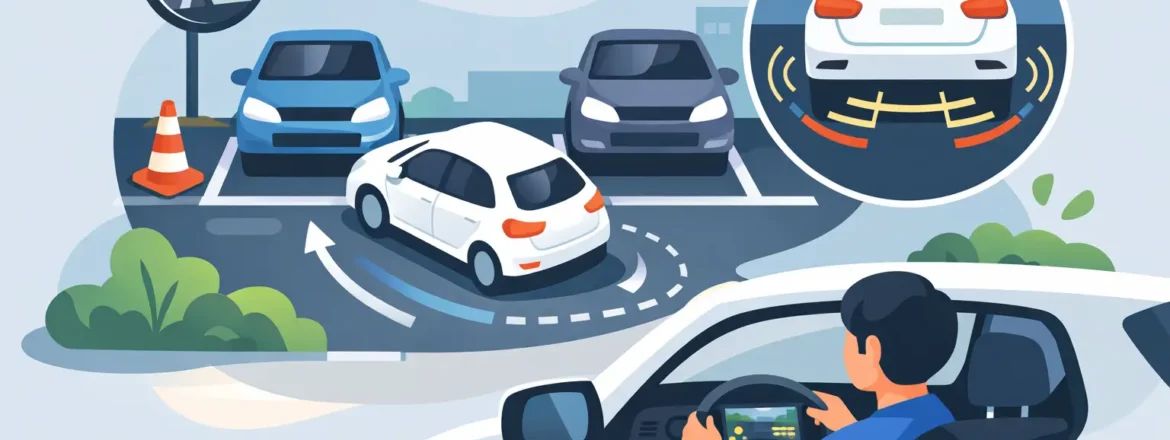
You can drive well for 40 minutes, handle roundabouts, keep your speed steady, and still feel your stomach drop when it is time to reverse park. That is normal. A good reverse parking step guide helps turn that panic into a repeatable routine, especially for learners preparing for everyday driving or a VicRoads test in Melbourne’s western suburbs.
Reverse parking is not about luck or sharp reflexes. It is about slow speed, clear reference points, and staying calm enough to make small corrections. Once you stop treating it like a last-minute manoeuvre and start treating it like a sequence, it becomes much easier.
Why reverse parking matters
Reverse parking is one of those skills that shows whether a driver is controlled under pressure. Anyone can pull forward into an easy space. Reversing in neatly, safely, and without rushing shows better observation, steering control, and judgement.
It also matters in real life. Shopping centre car parks, school pick-up zones, train station parking, and narrow suburban streets often leave you with limited room. In many situations, reversing into a space makes it safer to drive out later because you have a clearer view of pedestrians, cars, and trolleys.
For test preparation, reverse parking is also a useful confidence marker. If you can manage your mirrors, speed, steering and checks during this manoeuvre, the rest of your driving often becomes calmer too.
Reverse parking step guide
Before you even start moving, choose a suitable space. For learners, a bay with enough room on both sides is best. If the car park is packed or the angle is awkward, the manoeuvre becomes harder. In a lesson, we usually start with easier spaces first, then build up to tighter ones once the technique is settled.
Step 1: Set up your position
Drive slowly past the parking bay you want, leaving about one metre between your car and the parked cars beside the bays. Your car should be parallel with the row, not drifting too close or too far out.
Stop when your vehicle is just past the bay so you have enough room to reverse in. The exact reference point can vary depending on the car, which is why learners should practise in the same vehicle where possible. What matters most is being consistent.
Step 2: Check all around before reversing
Put the car into reverse and take a full look around. Check both mirrors, look over both shoulders, and scan for people walking behind you, moving cars, or trolleys rolling across the lane.
This is where many learners rush. They are so focused on the bay that they forget the area behind the car is the real risk zone. If anything is moving nearby, wait. Good driving is never about forcing the manoeuvre.
Step 3: Start reversing very slowly
Release the brake gently and let the car creep. Keep your speed walking pace or slower. If you reverse too quickly, your steering corrections become larger and less accurate.
As the rear of the car begins to move towards the bay, turn the steering wheel smoothly in the direction of the space. Do not spin the wheel suddenly. Reverse parking rewards patience more than aggression.
Step 4: Use your mirrors as your main guide
Your side mirrors will tell you far more than guessing through the rear window alone. Watch the lines of the bay and the position of your car relative to the vehicles beside you. If one side is getting too close, pause and adjust.
Many learners stare at only one mirror. That creates drift. Keep your eyes moving from left mirror to right mirror, then do a quick shoulder check before continuing. The car goes where your observation goes.
Step 5: Straighten the wheel at the right time
Once the car has entered the bay and the angle looks right, begin straightening the steering wheel so the vehicle lines up with the space. This timing is what usually separates a tidy reverse park from a crooked one.
If you straighten too early, the car may not enter fully. If you straighten too late, the rear may swing too close to one side. This is why practice matters. You are building judgement, not memorising a magic trick.
Step 6: Finish centred in the bay
Keep reversing slowly until your car is fully inside the lines and evenly positioned. Stop with enough room in front and behind if required, and make sure the vehicle is straight.
Then secure the car properly. In a real-world situation, that means checking your final position before getting out. In a test situation, it also means showing control and awareness right to the end.
Common mistakes learners make
The biggest mistake is rushing because another driver is waiting. That pressure is real, especially in busy areas like Point Cook or Werribee shopping strips, but it cannot control your decisions. If someone is behind you, stay calm and complete the manoeuvre safely. A few extra seconds is better than a poor angle or a near miss.
Another common issue is starting from the wrong position. If the setup is too close, the turn becomes too tight. If you are too far away, the car drifts across the bay lines. Learners often blame their steering when the real problem started before the reversing even began.
Oversteering is also very common. Big wheel movements usually lead to bigger corrections, then confusion. Small, steady steering inputs work better. If the car is going off line, stopping and resetting is perfectly fine.
Finally, many nervous drivers forget observation once they begin moving. Reverse parking is not only about fitting into the space. It is about checking continuously for hazards around the vehicle.
What if the park goes wrong?
It happens to everyone. Even experienced drivers sometimes need a second attempt. The key is knowing when to correct and when to start again.
If the angle is only slightly off, you may be able to pause, move forward a little, and straighten up before reversing back in. If the car is clearly crossing the line or too close to another vehicle, it is usually better to come out and reset the approach.
There is no prize for saving a bad setup. Learners often think restarting means failure, but in reality it shows judgement. Safe drivers do not force poor positioning.
Tips for nervous learners
A reverse parking step guide only works if you can stay calm enough to use it. Anxiety makes drivers grip the wheel too tightly, reverse too quickly, and forget their checks. The answer is not to think faster. It is to slow the whole process down.
Practise first in a quiet car park with clear bay lines and low traffic. Go at times when the area is less busy. Build consistency before adding pressure. Once the movement feels familiar, then practise in busier locations.
It also helps to use the same simple self-talk each time: set up, check, reverse slowly, steer, straighten, finish. Short phrases work better than trying to remember ten separate rules while you are already stressed.
If you are learning in Melbourne’s west, local practice makes a difference too. Different car parks, kerb layouts and traffic patterns can affect how comfortable you feel. Familiar roads and a calm instructor can speed up progress because you are not trying to learn everything at once.
Reverse parking for the driving test
Test conditions are different from private practice because nerves are higher. That means your routine matters even more. Examiners are not looking for perfection in one fluid motion. They are looking for control, safety, observation and sensible correction when needed.
If you hesitate briefly to make proper checks, that is usually better than rushing in with poor awareness. If you need a minor adjustment, do it calmly. The test is not there to catch you out. It is there to assess whether you can handle the car safely and responsibly.
This is why structured practice helps. An experienced instructor can show you where your setup is inconsistent, when you are turning too early, or why you keep finishing crooked. Sometimes one small change fixes a problem that has been frustrating you for weeks. That is often where local, one-on-one driving lessons make the biggest difference.
Building a skill you will actually use
Reverse parking is worth learning properly because it stays with you long after the test. It makes everyday driving easier, safer, and less stressful. More importantly, it teaches a mindset that applies across all driving – slow down, observe properly, and make deliberate decisions instead of rushed ones.
If reverse parking still feels harder than it should, that does not mean you are a bad driver. It usually means you need a clearer method and enough guided practice to make that method feel natural. Keep it steady, keep it safe, and give yourself room to improve one clean park at a time.