A driving test can be decided in seconds: a missed mirror check before changing lanes, entering a roundabout without giving way, or rolling through a stop sign because you were focused on the next turn. Knowing road rules is not about memorising answers for a test. It is about making safe decisions early enough that other road users can predict what you will do.
For learner drivers across Melbourne’s western suburbs, the challenge is often applying the rules while managing busy intersections, changing speed zones, cyclists, trams and unfamiliar test routes. The good news is that safe driving follows a clear pattern: look well ahead, read the signs, leave space and act calmly.
Road rules start with observation
Most driving errors begin before the vehicle moves. If you do not see a hazard, sign or changing road condition early, you are more likely to brake late, hesitate at an intersection or make a rushed decision.
Build a consistent observation routine every time you drive. Scan far ahead for traffic lights, speed signs, pedestrians and vehicles turning across your path. Check your rear-view mirror regularly, then use your side mirrors before braking, turning, merging or changing lanes. Before moving off from the kerb, always check mirrors and blind spots.
A blind-spot check is not a quick glance at a mirror. It means turning your head to check the area beside your vehicle that mirrors cannot show. This is especially important around cyclists, motorbikes and vehicles travelling in the next lane. In a practical driving assessment, assessors need to see that you are checking properly, not simply assuming the space is clear.
Speed limits are a maximum, not a target
A signed speed limit is the fastest you may legally travel in suitable conditions. It is not a speed you must reach. Rain, glare, heavy traffic, school activity, roadworks and narrow residential streets may all require you to drive more slowly.
In built-up areas, the default speed limit is generally 50 km/h unless signs state otherwise. However, drivers must pay close attention to school zones, roadwork signs, electronic signs and temporary speed changes. Speed signs can change quickly on routes around Werribee, Tarneit, Truganina and Hoppers Crossing, particularly where new estates meet major roads.
Keep checking your speedometer instead of relying on how fast the car feels. A wide, open road can make 60 km/h feel slow, while a narrow street with parked cars may make even 40 km/h too fast for the conditions. Smooth speed control also gives you more time to observe and make decisions.
Intersections, give way signs and stop signs
Intersections require patience. The safest driver is not the one who gets through first, but the one who gives way correctly and does not force another person to react.
At a give way sign or line, slow down and give way to traffic on the road you are entering, including vehicles approaching from either direction where relevant. Look for pedestrians and cyclists as well as cars. If your view is blocked by parked vehicles, creep forward carefully only when it is safe.
At a stop sign, come to a complete stop at the stop line. If there is no line, stop before the intersection where you can see clearly without entering the path of traffic. A rolling stop is not enough, even when the road appears empty.
When turning at an intersection, give way to pedestrians crossing the road you are entering. This is a common area of confusion because a green traffic light does not automatically mean you can turn without checking. If you are turning right across oncoming traffic, wait for a safe gap unless you have a protected right-turn arrow.
Do not enter an intersection unless there is room to clear it. Blocking a crossing because traffic ahead has stopped creates risk and inconvenience for everyone, including pedestrians trying to cross.
Roundabouts: plan your approach
At a roundabout, give way to vehicles already in the roundabout. Approach at a speed that allows you to assess traffic without stopping unnecessarily, but be ready to stop if needed.
If turning left, indicate left as you approach. If turning right, indicate right as you approach and keep the right indicator on until you are ready to exit. When travelling straight ahead, you usually do not need to indicate on entry, but you must indicate left when leaving the roundabout where practical. Check mirrors and blind spots if your movement could affect another road user.
Large roundabouts can feel busy, particularly near shopping areas and main roads. Do not follow the vehicle in front too closely just because it entered. Make your own decision about whether the gap is safe.
Lane changes, merging and keeping left
Changing lanes is a planned manoeuvre, not a last-second correction. Use the mirror, signal, head check routine: check mirrors, indicate for long enough to give other drivers notice, check your blind spot, then move only when there is a safe gap. Keep your indicator on until the lane change is complete.
When lanes merge, do not assume another driver will make room. Match your speed to the traffic flow where possible, look for a suitable gap and give way if your lane is ending. Sudden braking or forcing your way in can create a dangerous situation.
On multi-lane roads, keep left unless overtaking, turning right, making a U-turn, avoiding an obstruction or traffic conditions make it impractical. More importantly for learners, choose the lane that gives you the clearest and safest path well before your turn. Late lane changes are a frequent cause of test mistakes and near misses.
Safe gaps protect you when others make mistakes
Leave at least a three-second gap behind the vehicle ahead in good conditions. Pick a fixed object such as a sign or power pole. When the vehicle ahead passes it, count “one thousand and one, one thousand and two, one thousand and three”. If you reach the object before finishing, increase the gap.
Allow more space in rain, at night, on loose surfaces or when following a heavy vehicle. A safe gap is not wasted road space. It is your time to notice brake lights, check mirrors and slow down smoothly rather than reacting sharply.
Space matters at intersections too. When waiting behind another vehicle, stop far enough back that you can see its rear tyres touching the road. This gives you room to move around if needed and reduces the chance of a minor collision if traffic stops suddenly.
Sharing Melbourne roads with pedestrians, cyclists and trams
Learners need to expect vulnerable road users, especially near schools, stations, shopping strips and local parks. Pedestrians may step out from between parked cars. Cyclists may need to move around potholes or parked vehicles. Give them room and avoid overtaking where the road narrows.
When passing a cyclist in Victoria, leave at least one metre of space in speed zones up to 60 km/h and at least 1.5 metres where the limit is above 60 km/h. Wait behind them if you cannot pass safely. A few extra seconds is always better than a close pass.
Trams need particular care in Melbourne. Watch for passengers getting on and off, and follow signs and road markings around tram stops. If passengers must cross the road to reach a tram, you may need to stop and wait. In the CBD, hook turns are permitted only at signed intersections. They require you to position correctly, wait for the traffic lights to change and complete the turn when it is safe. Do not attempt one unless you understand the signs and procedure.
Road rules for learner and probationary drivers
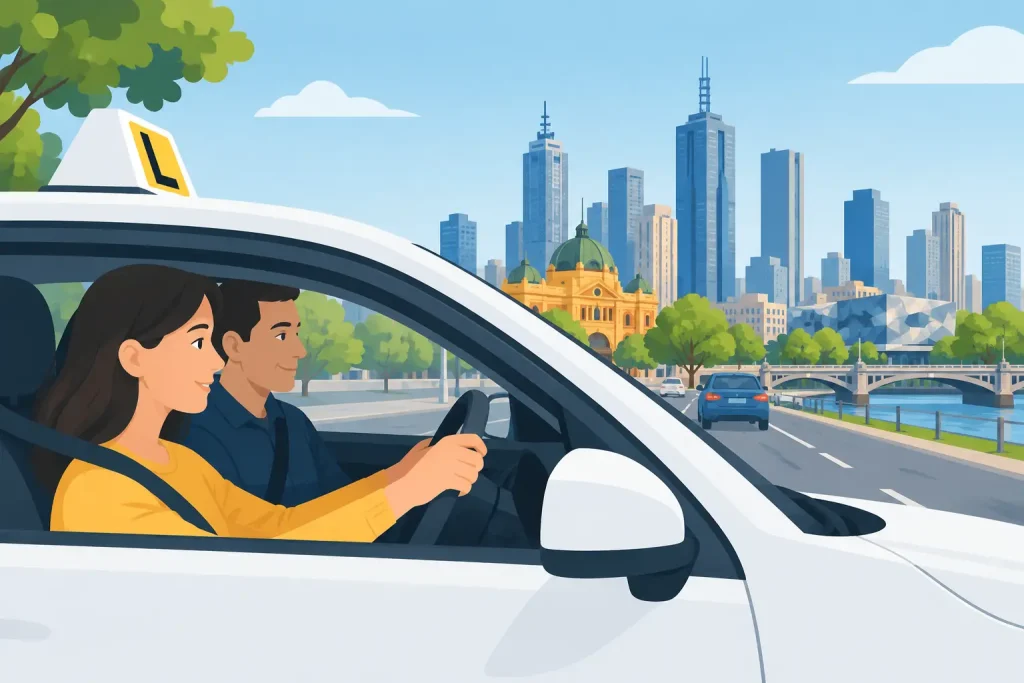
Learner and probationary drivers have extra responsibilities. You must display the correct L or P plates, carry your licence as required and follow passenger and supervision conditions that apply to your licence stage.
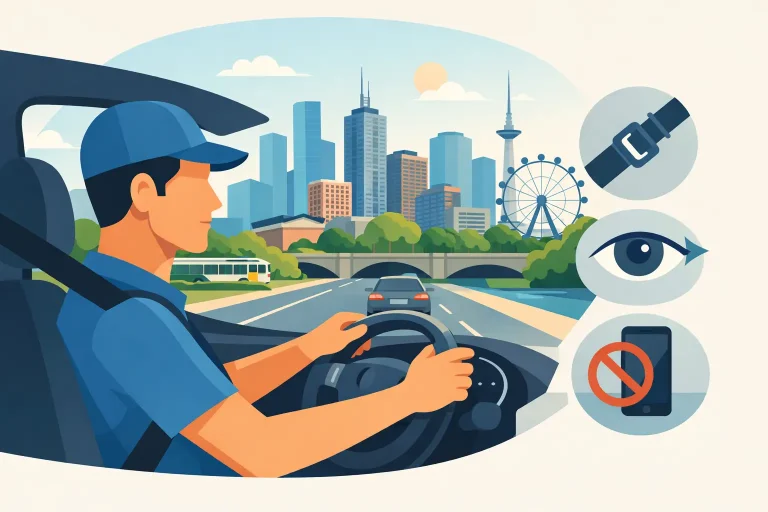
Alcohol and mobile phone rules are especially strict. Learner and probationary drivers must have a zero blood alcohol concentration. They must not use a mobile phone while driving, including hands-free functions. Set navigation and music before you begin, then leave the phone alone until you are safely parked.
Every person in the vehicle must wear a properly fitted seatbelt. Before moving off, check that doors are closed, passengers are settled and loose items are not likely to roll under pedals or distract you.
Practise road rules in real situations
Reading the rules is useful, but confidence comes from practising them in traffic. A quiet street is a good place to build steering and braking control. Then progress to roundabouts, busy intersections, lane changes, parking areas and higher-speed roads as your skills improve.
A professional lesson can help turn confusing rules into repeatable habits. At Victest Driving School, learners receive practical feedback on observations, speed control, positioning and local test-route situations, with the aim of building safe driving habits that last beyond test day.
Before each drive, give yourself one focus area – perhaps earlier mirror checks, smoother braking or better lane planning. Small improvements repeated over several lessons make the road rules feel natural, leaving you calmer, safer and better prepared whenever the road becomes unpredictable.